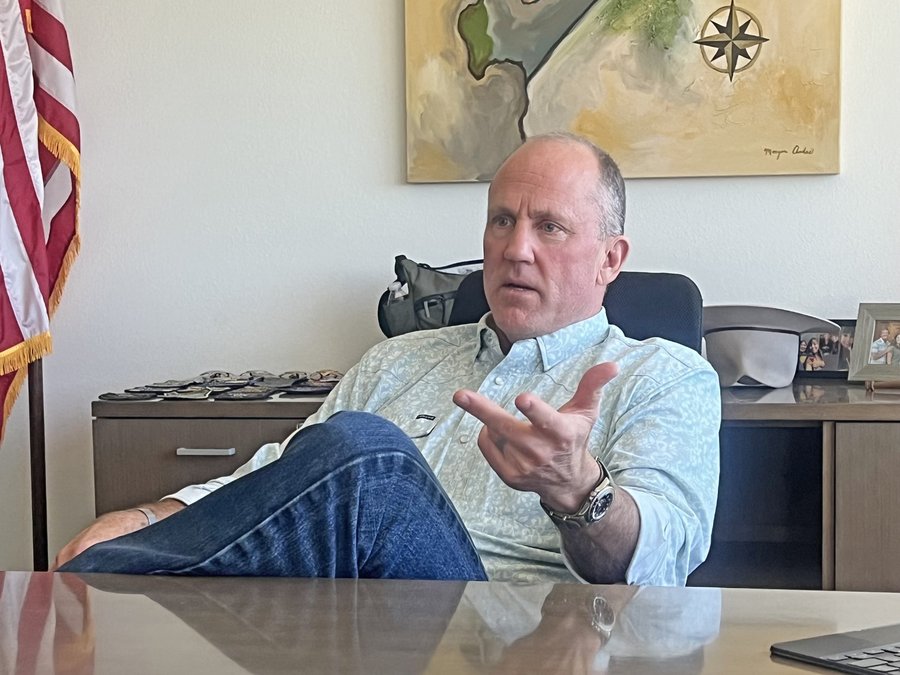
(Editor’s note: Ceres Courier reporter Joe Cortez recently sat down with Stanislaus County Sheriff Jeff Dirkse for a wide-ranging, two-hour interview in his office at the Stanislaus County Public Safety Center.)
Joe Cortez: Let’s start with a one, big general question. What is the status of crime in Stanislaus County?
Jeff Dirkse: Generally speaking, crime is down overall. But here’s the issue with stats: Our current system is old and archaic — and this will probably lead into a question about Oracle — and we don’t want to dump a bunch of money into an old system, right? I think that would be a waste of taxpayer money. So, part of the issue with statistics is our computer system.
But, crime is down. And it has been going down, really since COVID, with a couple of minor blips in there. Historically, we would average 12 to 15 homicides a year pre-COVID. And post-COVID, it must have been 2020, I think we had nine. That’s the lowest anybody could remember. And it’s been three to five the last few years. The violent-crime index is down 15 percent, and the property-crime index is down 10 percent, so crime is down overall.
JC: To what do you attribute the downward trend?
JD: A few things. On the negative side, I attribute it to people under-reporting crimes. When you talk about things like assaults or burglaries, I think a lot of people assume nothing’s going to happen. They figure if they’re not filing an insurance claim and don’t need a case number for their insurance, it’s just not worth the time. They don’t want to wait for the cops when all that was stolen was an old bike or an old TV or some cheap jewelry. So, I do think some crimes are under-reported.
On the positive side, there are a few different things. There is more technology now, right? Almost all the cities have a massive network of intersection cameras. We have some in the county, but our geography is way different, so it’s kind of a different problem. Turlock has some. Ceres, I think, has a few now. Oakdale has a lot.
The point is, we can catch criminals way faster because of that. If a guy robs a Quik Stop and flees, we might get a vehicle description, even if it’s only a partial description. Well, we can go back using those (Automated License Plate Reader) type cameras, and we might be able to narrow it down to a few vehicles. Then we can find the full license plate number, and then get the registered owner. Then you start showing pictures to the victims, and they’re like, “That’s that guy!” Now we can track that car, and we can track that guy.
Why does this matter? Because most of these criminals escalate over time, right? They might start by breaking into people’s houses to steal stuff so they can sell it to make money for drugs. But then they’re not making enough money doing that, so they start robbing the Quik Stop. Then, a robbery turns into a shooting and somebody gets killed. Well, if you can take them out of circulation for the burglary or the earlier robbery, then there’s no escalation to those bigger crimes over time.
So, that technology piece is significant to our ability to take people off the chess board, so to speak, before they get to committing more serious crimes.
Look at marijuana grows. Historically, this office didn’t really do anything about illegal grows. When I became sheriff, I determined that we were going to go after these. Every year, we’ll have one to three homicides directly related to an illegal grow, though we’ve not had one now in several years. But it’s a big-time cash crop. If I know that you’re growing weed, and I know you’ve just harvested, I might want to go and grab some bud from you because I can sell that. You’ve got 50 pounds of bud, and I don’t have to do any of the work. So, I break into your house, there’s a confrontation, I shoot you, and you die. There’s a homicide. Or you shoot me and I die. There’s still a homicide. Whether it’s justified or not is a separate conversation — there’s still a homicide investigation. But by aggressively going after the illegal grows, we’ve taken a lot of that off the table.
And, in addition to cameras and going after illegal grows, there’s our network intel analysts.
Traditionally, cops and detectives did a lot of the gumshoe work, right? Tracking leads and knocking on doors. Well, now we have a whole crew of crime analysts. They are not sworn law enforcement officers, they’re civilians, and, they do intelligence work. They’ll mine social media and come up with a street name — I don’t know, let’s say ‘Snoopy.’ And they can ferret Snoopy out of all the databases and come up with a suspect profile. That kind of intelligence-driven policing is, to me, the wave of the future.
JC: It’s funny you mention that. I was thinking the other day about “Law & Order,” the NBC television show that’s been on since 1990. When it started, there’s a lot of old-fashioned police work. Knocking on doors, thumbing through mug books. Now, their storylines feature a crime analyst and modern police methods.
JD: That’s right. You know, I should take you to the STAC sometime if you want to write an article on that. The STAC — Stanislaus, Threat Assessment Center — is actually at the coroner’s office and that’s kind of our main hub for analysts. They have four or five that work out of there. We have a data scientist up there. There’s a couple of detectives up there, as well. It’s kind of a real-time crime center. And then we also have analysts spread across the organization. But they all network together, and they kind of do different things. The State Sheriffs Association formed an intel analyst committee, and I’m actually the chair of that committee. It’s one of those things where you bring up the idea and, hey, guess what!
JC: ‘Sounds like a great idea, Jeff. Here’s the gavel!’
JD: Exactly! But it really is the wave of the future.
JC: You’ve talked about analysts and intel, and how that’s the future of law enforcement. I think most everybody kind of understands that. But what are you leaving behind as you head into the future?
JD: What we’re leaving behind are situations where there’s a problem at a house that sounds bad, and we just go right up and knock on the door: “Hey, what’s going on inside? Let’s go see!” Then somebody answers the door and the fight is immediately on. Now, does that still happen? Of course. But we want to be able to get information into our deputies’ hands.
Let’s say somebody calls in a report that their brother is locked in the bedroom and is in possession of knives. We show up, and the brother comes charging of the bedroom with a couple of knives. Well, my guys don’t want to get stabbed, right? If we can get intel that says this guy is diagnosed with some disorder, or that he’s been 5150 multiple times, well, that’s useful information. He’s been known to carry knives. That’s useful information. He’s been arrested five times with a gun. Well, that’s different. Knives are one thing. But a gun? That’s a very different scenario. That’s useful information.
JC: So, what you’re leaving behind is walking into situations totally blind; the intel makes sure of that. I can absolutely see the value in that, for scenarios both large and small. Right now, I’d like to circle back to something you mentioned earlier when talking about crime statistics. You mentioned an outdated computer system and that it would likely lead to a question about the Oracle computer-aided dispatch (CAD) program. What is the present status of Oracle?
JD: The shortest version is that we negotiated a ceasefire between me and the county. The gist of it was, if we moved to CentralSquare for a period of time, then we can eventually move to Oracle. So, we’re currently on CentralSquare.
JC: Let’s quickly recap for readers who may not be familiar. You wanted to go with a dispatch system designed by software giant Oracle, which included a records-management system (RMS) and a jail-management system (JMS). Meanwhile, the county wanted you to utilize the CentralSquare product and remain part of the Stanislaus Regional 911 dispatch hub. Now that you’re on CentralSquare, how’s it going?
JD: It’s a debacle. It is everything that I said it was going to be.
I will say, that in and of itself, the system works. I will acknowledge that. But we have moved backwards.
We used to It is be able to do what we called a premise history. If we went to Joe Cortez’s house repeatedly, and he’s a gang member known to carry guns, we could enter that type of information under an address, a premise, a premises history. Well, we don’t have that anymore. They’re trying to somehow transition it from the old system into the new system. But so far, after six weeks, they haven’t been able to do so. They blame me. “Sheriff, you got in on this project so late, that’s why we couldn’t do it.” Well, why doesn’t Modesto PD have it? They’ve been on this now for a couple of years, and they don’t have that data, either. And in my opinion, I don’t believe they’re ever going to be able to move that data over. And I say that just as I’ve been talking about this idea of intelligence. It jeopardizes both the public and personnel. Every agency we’ve talked to says, “Don’t buy it; it sucks.” The rollout was horrible. It was not tested correctly. It’s just a debacle.”
JC: But Oracle remains a possibility for your department? Oracle hasn’t taken its ball and gone home?
JD: We bought a product called Unify — it’s actually a CentralSquare product — and it allows for CAD-to-CAD communication. Dispatch can operate off of CentralSquare via Unify, and then send us stuff that would show up on our screens in Oracle. So, the expectation is that in the next few months, we will begin the transition to Oracle, initially for our RMS and JMS portions.
JC: So, Unify is the cartilage between the off CentralSquare and Oracle bones, so to speak.
JD: Yes. But it’s frustrating because when you attempt to connect all of these different systems, you have to build a connection between everything. And that’s the type of thing that a company like Oracle is trying to avoid, so that you’re not building connections; you’re just using one thing. And it’s just because we’ve never addressed some of the root issues that we’re still fighting over it. It’s not getting better. And we’re not serving our community better, that’s for sure. And, by the way, we’re spending taxpayer money on all this.
JC: Will you be seeking reelection in 2028?
JD: Yes. I was on the fence for a long time. I really was.
JC: Why were you on the fence?
JD: A few different reasons. I tell people all the time, “I think George Washington got it right the first time.” And I still believe that. I believe in term limits. Two terms could be a little light. Maybe three, if you’re talking four-year terms. And honestly, some of this dispatch stuff has to get resolved. It’s been 25 years of this debacle.
JC: Did the Oracle situation factor into the decision?
JD: Absolutely. We’ve got to fix this problem. But the other thing that factored into it is, if I didn’t do this again, I wouldn’t do anything else in politics. I have no interest in going to Sacramento; I have no interest in flying to D.C. None, whatsoever. Period. Maybe a one percent interest in being a supervisor, at best. I would never say never, but I’m not interested in that. I have zero interest in politics. I’m jaded by politics. But my point is, I’m not just going to hang it up and do nothing. I’m way too young and way too energetic for that. So, I’m planning to run again, because stuff isn’t done, and we need to finish a few things. And I don’t know what else I would do. I hate that as an answer: “Oh, I don’t really have anything else to do, so I might as well run.” And I’m a relatively religious person. I keep it private, but it seems like this is what God wants me to do. I think I’m supposed to be doing this job, and He’s not indicating otherwise.”
JC: A few minutes ago, we stopped the recording to briefly talk off the record, and the subject of ego crept into that conversation. I don’t think I’m telling tales out of school by mentioning that. So, in keeping with that that theme of ego, take a moment to pat yourself on the back and tell us what you’re most proud of accomplishing during your tenure.
JD: One is the establishment of the STAC, which we talked a little bit about and our intel analysts network. And the work we’re doing statewide right now in getting them connected amongst all the other sheriffs’ offices; that’s huge. I think it’s the future of law enforcement in our region, and we are doing really well. I’m not going to necessarily compare us to other places, but we have a really strong intel apparatus, comparatively speaking. You go to Orange County, we look like amateurs, right? But it’s Orange County. They’ve got more money than they know what to do with.
I’m also very proud of our efforts against human trafficking. We definitively lead the region. We have really high arrest numbers around human trafficking, not because it’s worse here, but because we are committed to investigating it here. We dedicate resources to it; we have a very aggressive team that investigates it; and they’ve done some tremendous work.
We’ve talked about this idea of intel and real-time response. Well, we have probably the best drone unit in the region, hands down. We have a drone on duty 24/7/365. And we fly drones all the time, multiple times a day. They’re a tremendous asset.
We’ve also done some tremendous work in staff wellness. I had always wanted to focus more on physical fitness, but we’ve made progress on the emotional side. It’s very difficult to crack into. There are a lot of stigmas in this profession about, you know, “I’m having problems.” So, we’ve had to destigmatize it, and we’ve done a lot of work in that arena. We’re not perfect, but I’m unaware of anybody in the state that does what we do.
Do you know Suzy Powell-Roos?
JC: I do. I covered her when she was a high school athlete at Downey High School, and I’ve gotten to know her a little bit in her post-Olympic life.
JD: We’ve been friends several years, and I distinctly remember my wife, Sandy, and I were driving to a conference, and I said, “I need to call Suzy; I’m looking for a wellness coordinator.” So, I’m picking her brain: “Here’s what we need; do you know anybody?” And we get off the phone Sandy said, “Maybe it ought to be Suzy.” So, she’s our wellness coordinator now, and she does a phenomenal job. She is such a unique person that perfectly fits the department. Three-time Olympian, right? From a physical standpoint, she understands fitness, working out, discipline, all of that. But there’s a lot of mental preparation that goes into that, too. You’re throwing a discus in front of the world and controlling your mind, like we would have to do on a critical incident. She also connects with female staff members who would be less inclined to go to a CrossFit dude or something. She’s a contractor; she’s only 10 hours a week or something like that. But she’s amazing.
JC: So, you recruited a three-time Olympic discus thrower to be your wellness coordinator. How is recruitment overall in the department?
JD: Recruitment is good.
JC: Where are you at as far as staffing?
JD: I don’t know that number. Ever (laughs). We have two different sets of numbers here, and we fight about this internally all the time. Tori (Hughes), my patrol captain, always counts butts in seats. “How many people do I have to deploy and actually get on the street?” (Undersheriff) Mickey (LaBarbera) and I track actual employees. We track people going in the training pipeline. And then we track people in the background, because I can’t exceed my authorized numbers. So, we’re authorized for 208 ops deputies. And custodial deputies are like 320, 321. And then there’s sergeants and lieutenants on top of that. But we have 208 ops deputies.
Before I became sheriff, we were losing 15 to 25 a year laterally to other agencies. We were just a training ground. But we created a Deputy Sheriff II — there’s Deputy Sheriff I and Deputy Sheriff II — and there’s some training requirements around it. And if you meet those training requirements, it’s an automatic pay bump of 10 percent more. That helped definitively, and the Board of Supervisors passed it, and it was great for the board to do that. At the time, I think 70 percent of our staff met the requirements, and they immediately got 10 percent more pay for, really, doing the same thing. So that was super helpful.
And then, you know, people leave a job. This is, technically, my eighth year. In my first seven years, we averaged about one true lateral move a year, with a little bit of a caveat: I don’t count what I call the change of lifestyle. People want to go live in the mountains. That’s a change of lifestyle, right? I can’t help that. We’ve had people go to Texas, Idaho, Tennessee, you know, because they hate it here and they’re getting out of California. Can’t help you with that one. Wish I could. So, you might be able to count about 20 cumulative laterals in seven years, but nothing like the 15 to 25 per year. It’s been very stable. When I became sheriff, we had about 160, 165 deputies, and now we tend to average in the 185 to 200 range.
JC: We’re just about at the end of our time. Is there anything else you’d like our readers to know? Anything. Dealer’s choice.
JD: I think, Joe, at this point, we’ve probably covered it. My number one emphasis right now is really in this intel space. The STAC, dispatch, it’s all interrelated, right? It’s all intertwined and interconnected. It’s the future.
JC: Sheriff, thank you. I appreciate the time. You’ve been incredibly generous.
JD: Happy to do it.