By GARTH STAPLEY
Central Valley Journalism Collaborative
When summer heats up in Modesto, so do its famed food processing plants.
During canning season, the four largest, including Del Monte, generate the same amount of sewage as a city of one million – between four and five times Modesto’s actual population.
Government and nonprofit entities brag about Modesto’s rightly deserved place atop the food and beverage ecosystem, offering canneries as proof.
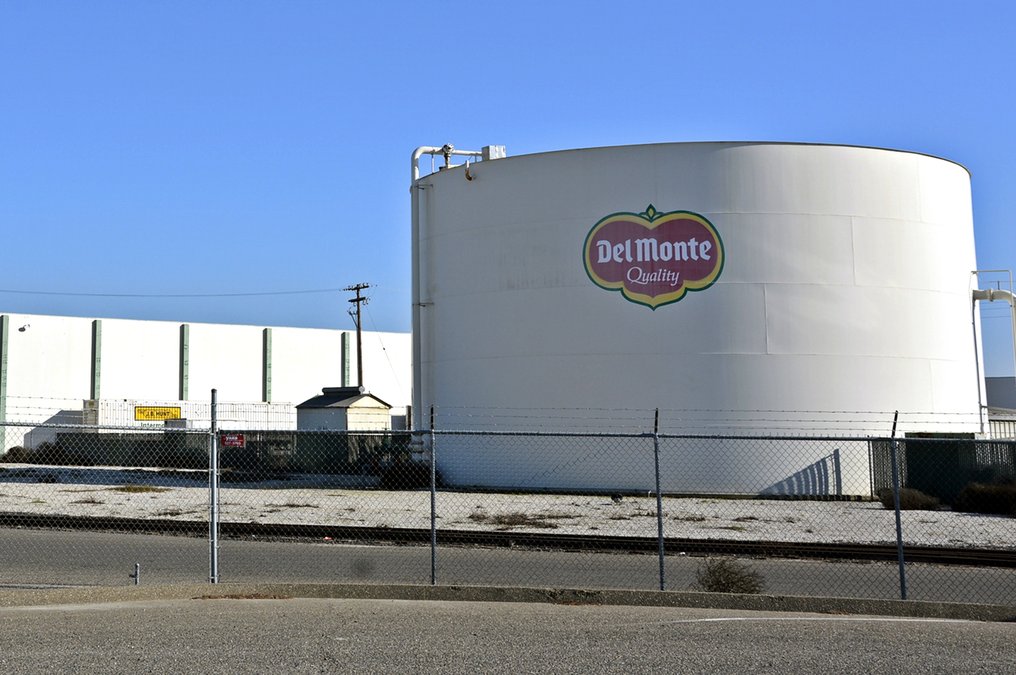
But the food-packing season won’t be quite the same this year. Del Monte Foods – long a cornerstone of Modesto’s food processing legacy – is calling it quits. Its venerable plant, in the Beard Industrial District just north of Ceres, is closing and will lay off 1,800 workers making from $20 to $40 an hour as part of the 140-year-old company’s bankruptcy, Del Monte said in an announcement.
In a recent CapRadio interview, Vito Chiesa called the closure “a tough gut punch.” He’s chairman of the Stanislaus County Board of Supervisors, but on a personal level, his family farm went through a bankruptcy with another cannery, Tri Valley Growers – costing the Central Valley some 11,000 jobs in 2000.
Between those devastating failures came numerous others in the food-processing industry with a combined loss this century of more than 20,000 jobs, a Modesto Focus analysis shows.
Is Modesto losing its food-production mojo?
“I feel bad for the people who worked at Del Monte forever,” said Maryn Pitt, policy director of the Manufacturers Council of the Central Valley. But she and other experts say that despite periodic bad news, food production remains an important anchor to the area economy.
Among the heavy hitters are the E.&J. Gallo Winery, Crystal Creamery, SunOpta and Stanislaus Food Products.
Consumers prefer fresh food, not canned
Del Monte’s demise serves as a warning to other fruit and vegetable packers, said Gökçe Soydemir, a business economics professor with Stanislaus State University. Some “miscalculated,” he said, with investments in canned food production as people ate more shelf-stable food during COVID-19’s stay-home stretches, a short-lived trend.
“Specific to Del Monte, we’ve seen a shift in consumer patterns” over time, he said, from canned to fresh food.
Pitt said, “Think how little space canned food takes up in the grocery store” now compared to years ago, when grocers carried mostly staples. Catering to demand, many now offer sushi platters, rotisserie chicken and more prepared food, she said.
Bill O’Brien, a co-owner of O’Brien’s grocery stores in Modesto, recalls a time when frozen juices filled two freezer compartments. Now his stores carry about a half-dozen frozen-juice items – and lots more fresh juices.
“Trends are always going to evolve,” O’Brien said. “But,” he added, “ag is still king” in these parts.
Local fruit farmers left out in the cold
Growers contracting to deliver fruit to Del Monte are feeling the sting, wrote Caleb Hampton, Ag Alert editor. The Modesto plant processed more than 40 percent of Valley-grown pears, he wrote, and a significant portion of peaches and apricots as well.
Most of the rest goes to Lodi’s Pacific Coast Producers, which acquired some of Del Monte’s assets in New Jersey bankruptcy proceedings that started in July with hopes that another company would step in and keep open the Modesto plant. None did, and the bankruptcy was finalized Jan. 29, leaving area growers in the cold.
It can take 10 years for a peach farmer, for instance, to recover the investment of planting a peach orchard, Hampton wrote, saying, “Del Monte’s exit from the sector means many growers may never make their money back.”
Also out of luck are companies in related sectors, supplying cans, packing cartons, boxes and such. One in eight local jobs is “directly tied to agriculture or related food manufacturing, placing our county at some risk unless we continue to diversify,” warns the Stanislaus County Comprehensive Economic Development Strategy.
Others hurt by the Del Monte collapse could include, believe it or not, Modesto City Hall, and by extension, its taxpayers.
City officials will be forced to adjust to less wastewater revenue with Del Monte leaving, utilities director Will Wong told The Modesto Focus. The city relies on that revenue to make payments of $4 million to $5 million a year on a $144 million upgrade to its sewer system, approved in September.
Del Monte’s sewage bill was about $861,000 a year, the city said in documents used to attract investors in a $60 million bond for the sewer upgrade.
A couple of decades ago, the city installed a huge sewer pipe carrying just wastewater from Gallo, Stanislaus Foods, Frito-Lay and Del Monte. It’s poured onto farmland instead of being treated with other municipal sewage.
Del Monte’s departure frees up some wastewater capacity for other businesses, Wong said. But “it remains to be seen if someone else will come,” he added. “It’s a waiting game to see what true impacts this will have to our city.”
Help available with job searching
Opportunity Stanislaus will aggressively market the Del Monte property, CEO Dave White said. “We’ll market it like crazy, trying to find a company that’s growing and wants to be in this market,” he told The Modesto Focus. “We’ll scour the data bases to see who’s growing and thriving, and will work with their real estate broker.”
His organization hosted a job fair in Oakdale a couple of weeks ago that attracted anxious Del Monte workers, White said.
They’re encouraged to seek opportunities with Stanislaus County Workforce Development. Its board chairman, O’Brien, said, “There are programs and monies available for exactly what’s happening” with Del Monte.
Workers who know how to operate a palletizer – an item-stacking machine – might get lucky with an area logistics company, said Pitt. Human resources and accounting skills also could transfer to another sector, she said.
Soydemir, the Stanislaus State professor, recommends that anyone in a low-wage job seriously consider upgrading their skills. People who work in stores and hotels are particularly vulnerable, according to his twice-yearly publication, the San Joaquin Valley Business Forecast.
His advice: “Go out there and get a skill. Invest in your future.”
— Garth Stapley is the accountability reporter for The Modesto Focus, a project of the nonprofit Central Valley Journalism Collaborative. Contact him at garth@cvlocaljournalism.org.