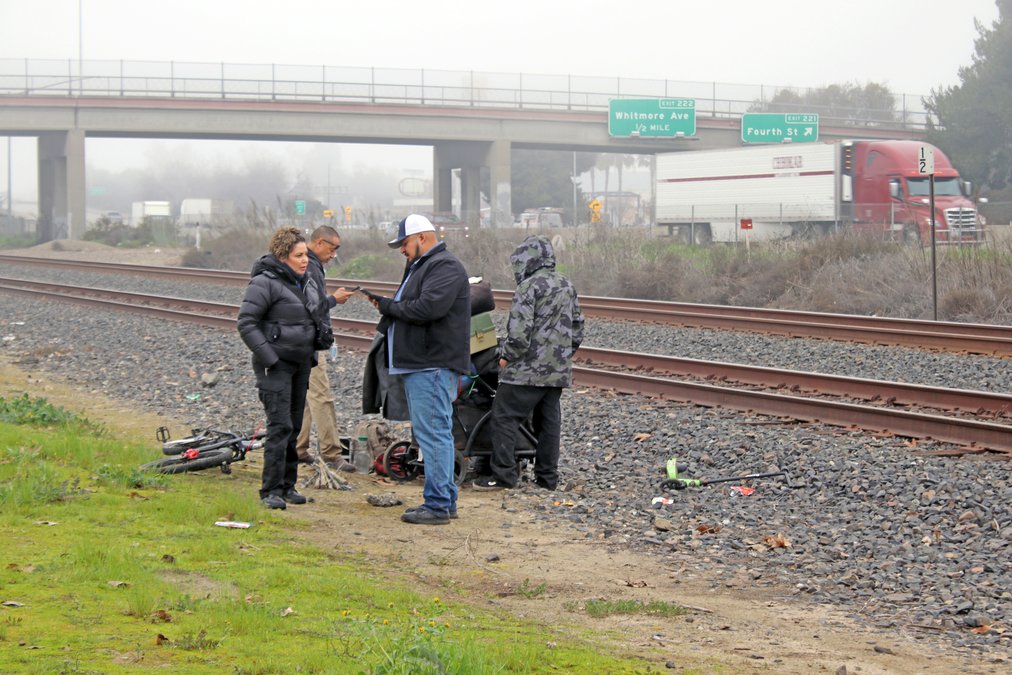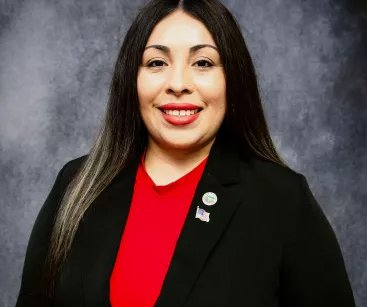
Over the loud roar of Highway 99 traffic, Gloria Arroyo approached the oleanders lining the west side of the freeway Thursday morning in search of homeless persons only to be startled by the sound of a dog barking. The substance abuse case manager strained to see then dog and a homeless man moving inside a thick nest inside the bushes where he spent the night.
“Outreach!” said called out and a disheveled man wrapped in a blanket peered through the oleanders and responded to her offer of a free backpack if he answered some questions.
Arroyo, a member of the Stanislaus County Community Assessment Response & Engagement (CARE) team, found out the man’s drug of choice was meth but admitted to using marijuana. This is her full-time job but Thursday was different in that the Point in Time Count — a one-day, unduplicated count of sheltered and unsheltered individuals and families experiencing homelessness – took place.
This year the count was a challenge due to a lack of enough volunteers to canvas the locations where the homeless are known to congregate.
Last year 18 persons were counted as Ceres’ unhoused population but the accuracy of the count is questionable. The 2025 count also recorded 2,086 unhoused in the county. The data is useful for the Stanislaus Community System of Care (CSOC) in understanding who makes up the local homeless populations and their challenges to accessing services and ultimately getting housed.
The U.S. Department of Housing and Urban Development (HUD) requires all local Continuums of Cares (CoCs) to conduct PIT counts as a condition to receive funding. The numbers are used to determine funding allocations to address homelessness.
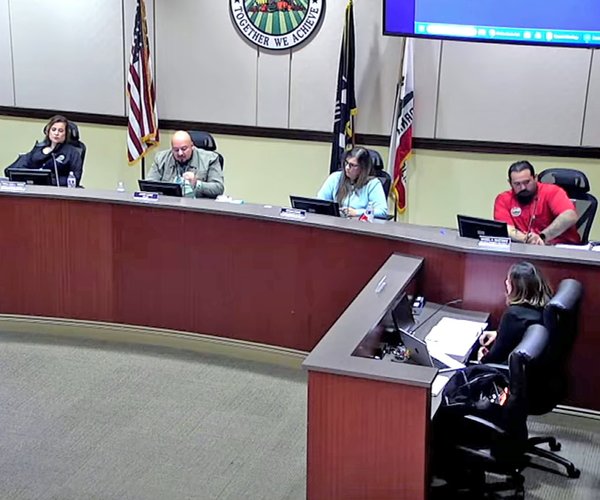
Assisting in the Ceres count Jesus Ascencio, a behavioral health specialist with Stanislaus County’s CARE team assigned to Ceres. Tagging along for the day to observe were Ceres Mayor Javier Lopez and City Councilwoman Rosalinda Vierra.
Aside from the one-day-a-year count, the outreach has the CARE team helping the homeless connect to drug and mental health services, secure IDs, birth certificates and Social Security numbers and other documents they need to submit an application for low income housing.
“It’s about reaching out and saying, ‘Hey, here’s resources,’” said Ascencio. “That’s what we do day to day. Every day, morning and afternoon.”
For many, say Arroyo and Ascencio, being on the streets and living along freeways, under bridges and along the river is a choice. Arroyo remains convinced that drug and alcohol abuse is the root cause of the homeless problem.
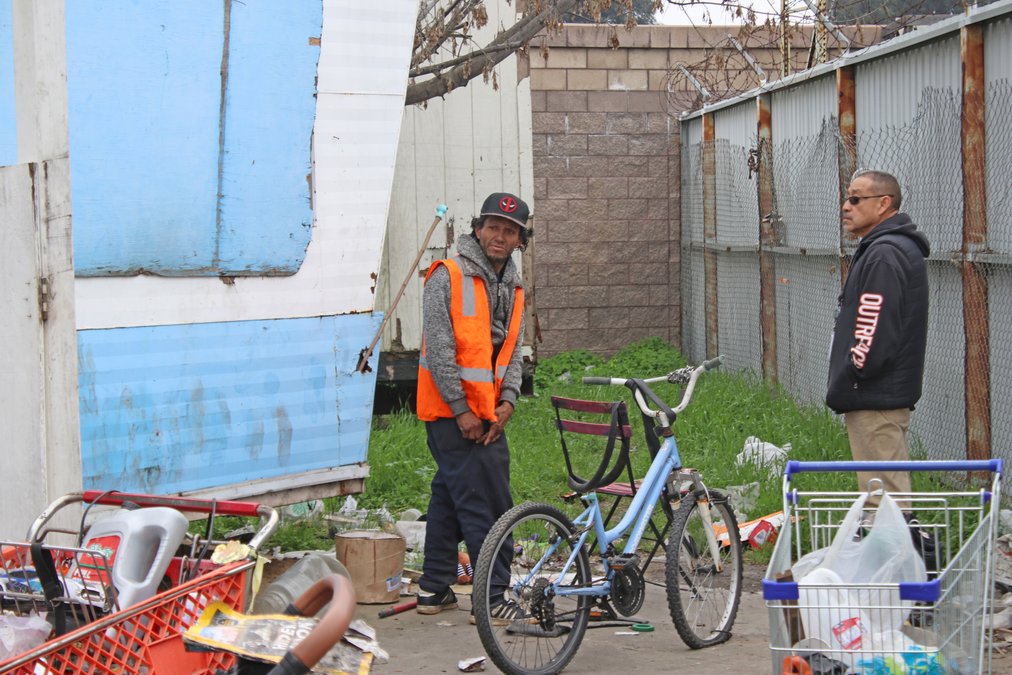
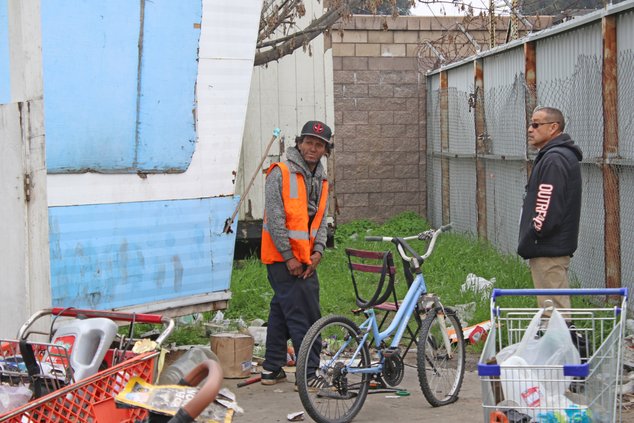
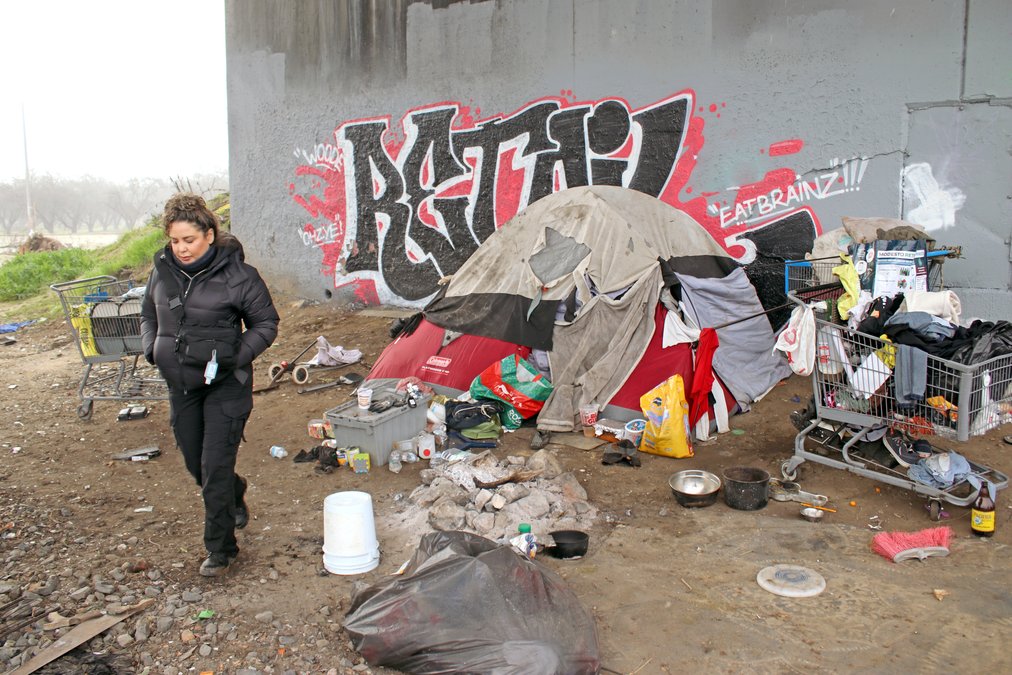
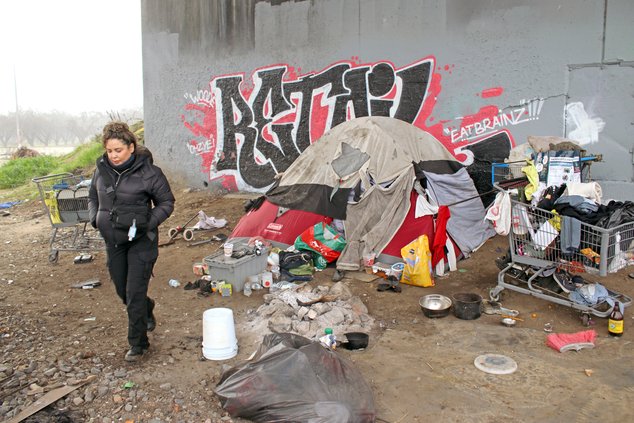
Under the Service Road freeway overpass Arroyo approached a tent staked amid trash and debris and called out. A woman’s voice called back, declining to participate so Arroyo was unable to pinpoint if there were any besides her.
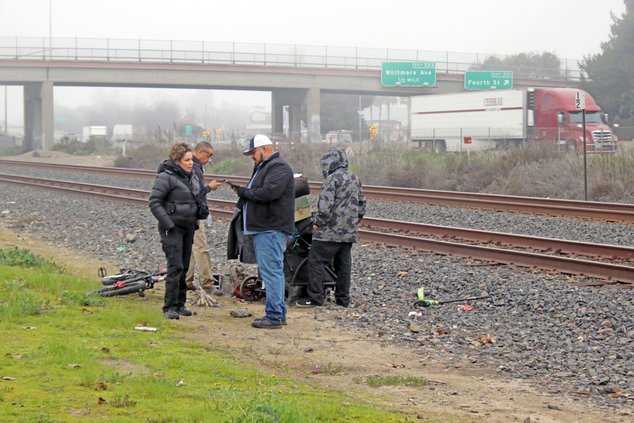
The team drive down the Union Pacific Railroad tracks to encounter more individuals. One homeless man recognized Arroyo from prior contacts and asked if she had any socks. She did and stopped the SUV to fetch a pair from the back.
Another homeless man named Anthony spoke to Ascencio and was given fentanyl test strips to help him check his drugs for the presence of the dangerous drug. The team also routinely hands out Narcan to be administered to overdose victims and spare their life. Anthony also shared that he had an upcoming court date to appear for charges and asked if the CARE team could give him a ride to Modesto so that he wouldn’t have to ride the bus.
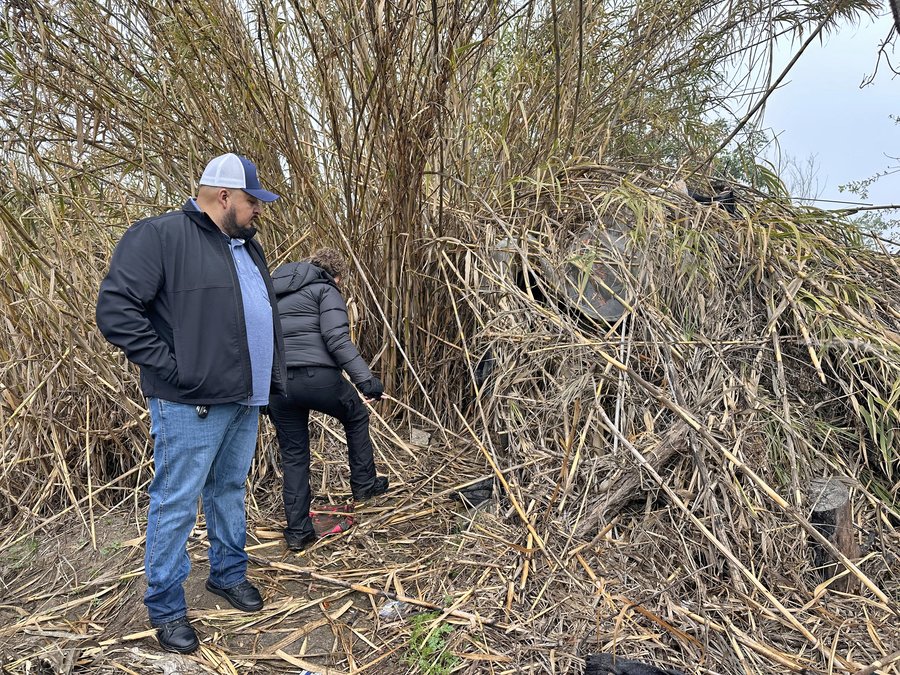
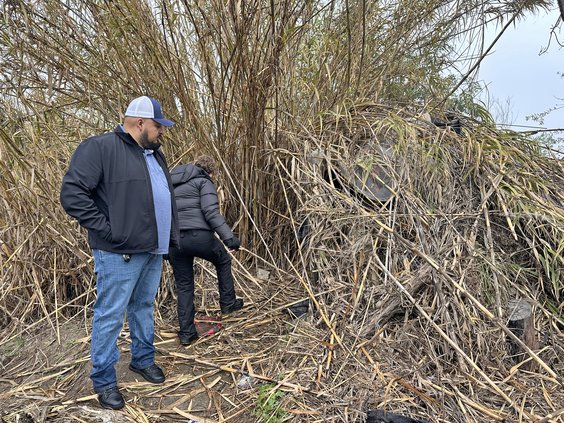
The morning began checking out the area along the Tuolumne River on the north side. To access the secluded area, the team had a long walk from the Beard Industrial Tract through fog and tall grass as the odor of Gilton’s waste station wafted through the air. After minutes of walking, Mayor Lopez stumbled upon a trash-strewn makeshift camp crafted of vegetation underneath the approach zone of the Modesto Airport.
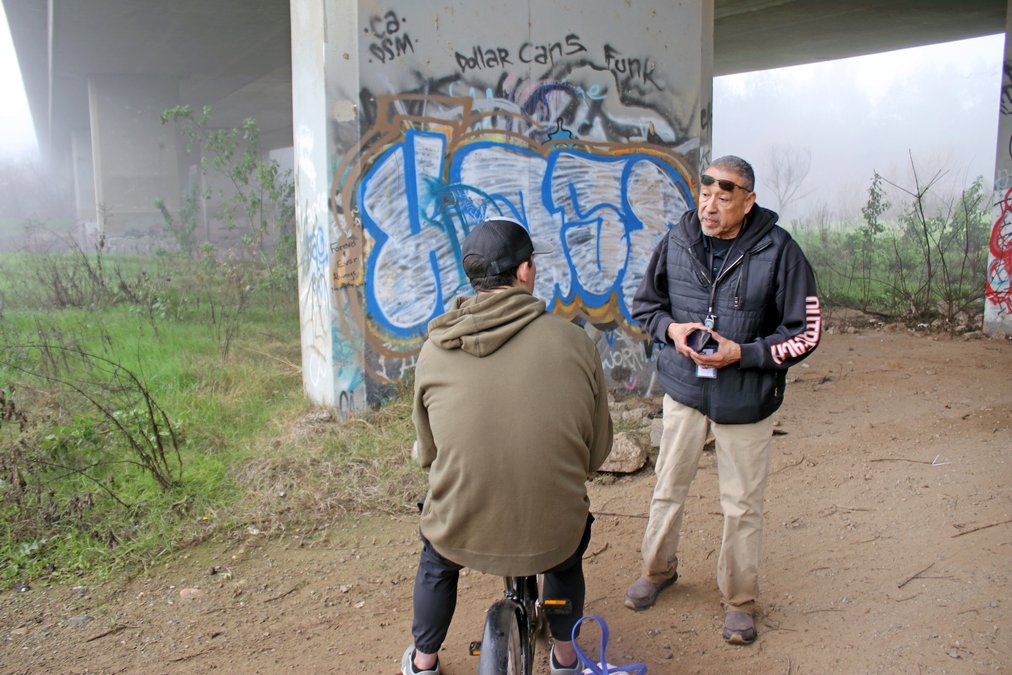
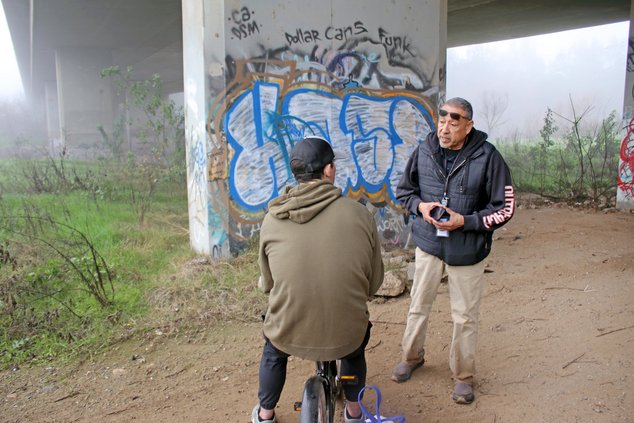
Under the Mitchell Road bridge, Ascencio found a young man on a bicycle who agreed to be answer questions. He explained that he came to California from his native New York after serving eight years in the military where he saw combat action. He is homeless due to a drug problem but agreed to have Ascencio reach out to connect him this week with housing options.
Typically that means shelter at the county’s homeless shelter at Ninth and D streets in Modesto. The ACES shelter, short for Access Center Emergency Shelter, operates a 182-bed facility in the Salvation Army’s Berberian Center on Ninth and D streets near downtown Modesto. It’s one of two shelters at the same location, both operated by the Salvation Army; the second has 180 beds. The Modesto Gospel Mission also has a shelter with 150 beds on Yosemite Boulevard.
In its five-and-a-half years open, ACES has provided shelter for 2,762 people, some staying longer than a year. Many have taken advantage of programs offering mental illness or substance abuse treatment, and 213 have moved into temporary, transitional or permanent housing.
The local shelter allows homeless persons to check into the shelter at 10 p.m. and they can’t leave before 6 a.m. unless they have a job. They also get a meal. Pets have to be on a leash and proof of vaccinations. Drugs are strictly not allowed.
Councilwoman Vierra noted the places she routinely sees the homeless, mentioning the Ceres Community Center where they hang out and charge their phones and the four or five who routinely hang out in Whitmore Park and camp on the gazebo.
“It’s one of those things,” said Ascencio, “like, the guy came at me when, (and said), ‘What am I supposed to do? I can’t I go to the sidewalk. I can’t go to the park. I come over here, I get kicked out.’ And he’s a VA guy. He’s a veteran. He wants services and so I told him, ‘Here you go, give me a call,’ because when they call me, they’re ready to take the next day.”
Most of the unhoused are willing to speak to the CARE team while at least one individual is hands off because, as Ascencio put it, “he’s just not very nice.”
Ascencio said Ceres police and Code Enforcement are very helpful to the CARE team when it goes out for routine contacts.


The problem in Ceres is not unique with a homeless persons commonly camping out or hanging out in commercial areas because they know sympathetic members of society will look be compelled to buy products – such as donuts or fast-food – and hand them out. It’s the same reason why they sit atop the Hatch Road overpass and hold signs asking for money.
The few volunteers who came out – they were from Catholic Charities – were instructed to not approach anyone actively doing drugs and told one sign of active use would be sitting with a blanket over their head.
In driving around Ceres, Arroyo reflected on the difficulty of finding volunteers for the once-per-year survey.
“Who wants to come over here on a Thursday morning when it’s foggy and go count homeless people?” she asked rhetorically.
Being a member of the CARE team has put Ascencio and Arroyo in harm’s way even though the job comes without hazard pay.
Arroyo said many who are on the streets are dealing with mental health issues, noting “it’s a different culture.”
Vierra noted that unhoused women in need of money or food are particularly vulnerable to sexual predators.
“I’ve had some of them share that people approach them and say, ‘I’ll buy you groceries, or I’ll pay for this, if you have sex with me.’ And I’ve had students approach me and say, ‘Yeah, this is what I had to do to buy my bills, or get my dog food for the night.’ And then a lot of times, they’re sleeping during the day, because it’s warmer, and at night, they’ll freeze to death or die if they sleep at night. So they’re generally asleep during the day, and they stay awake at night to stay alive.”
Arroyo agreed, saying “Yeah, I think we had like three or four deaths already – the homeless dying, freezing to death. I think that happened. That’s where they move in.
When asked what her solution to the state’s homeless problem would be, Arroyo said she’d like to see government “build a lot of drug and alcohol facilities that teach life skills – you can’t have one without the other.”
“If I were to put a client that was on the streets into a house, they would freak out – especially a person who was on drugs. They would freak out because that’s not what they’re used to.”
Vierra agreed, saying: “They don’t know how to take out the garbage. They don’t know how to clean up after themselves. Even now, they put them in the hotel overnight and they’re used to still defecating in the corner and not wiping, not showering, even though they’re in a hotel room with a toilet and a bed, they’re still used to the routine.”