
When the first Don Pedro Dam was constructed of concrete in the 1920s, it was a worldwide marvel as the tallest dam in the world.
The first Don Pedro Dam bore a plaque with the name of Ceres farmer Fred W. Moffet who served on the Turlock Irrigation District (TID) board. A visionary, Mr. Moffet knew that a plentiful supply of water would mean prosperity for farmers in the Ceres area. The dam was a joint project of both the Modesto and Turlock irrigation districts.
But another Ceres man had much to do with the building of the second Don Pedro dam which came along after years of planning.
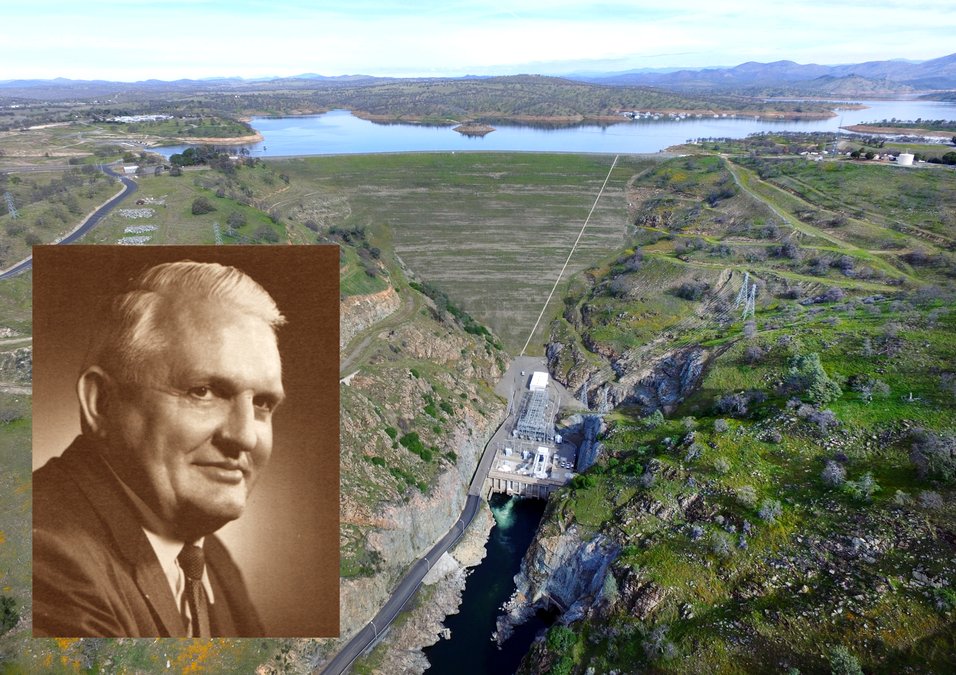
Charles Crawford, who was born at a Ceres home on Nov. 30, 1908, became the Irrigation Engineer for the Modesto Irrigation District and in 1967 was named the dam’s project coordinator, representing the three partners on the river. Charles S. Rippon, a veteran U. S. Bureau of Reclamation engineer, was named assistant.
The task of building the monstrous dam took years, millions of dollars, a lot of ingenuity and some trial and error.
One of Crawford’s first tasked after being appointed was to meet with the Highway 120 Association in Tuolumne County to discuss rerouting the Mother Lode highway, which ran through Jacksonville, and the acquisition of the town. This historic community dated from 1848, when Colonel Alden Apollo Moore Jackson, a miner turned merchant, set up a supply and amusement center in a tent for the miners along nearby Moccasin and Woods Creeks.
Most Tuolumne County residents favored the north routing, but a vocal majority, sparked by people in the Wards Ferry area, preferred the south side. The southern route would be more expensive, require an extra bridge and mean a longer drive for Northern Californians headed for Yosemite, but the districts argued for the northern route and lost. CalTrans insisted the southern route would be more convenient for its future plans to relocate the Highway 120 route to Yosemite.
Building a reservoir meant nearly 7,000 acres of land had been stripped of trees, brush, stumps, utility poles, driftwood, fences, buildings and anything that might float. Clearing began on October 3, 1967 and before it was finished on March 31, 1971, everything had been burned and the ashes buried. Only patches of brush designated by California Division of Fish and Game representatives were left to encourage the propagation of fish. Trico Contractors also had to remove an abandoned Hetch Hetchy Railroad bridge to improve boating safety. Anything man-made was hauled away or buried.
Old mine shafts had to be located and sealed with concrete seals at the bottom and filled with dirt. Thick concrete caps were placed on entrances to the shafts. The reservoir had to be as water tight as the dam itself.
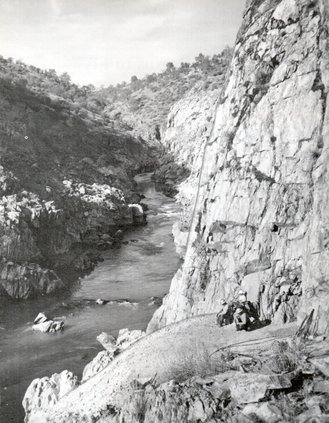
A diversion tunnel had to be built to channel the Tuolumne River while the powerhouse was constructed deep in a canyon before the massive earth filled dam was constructed.
On May 28, 1970, Modestan George Koetsky wheeled his 125-ton earth mover across the dam with TID Chief Engineer Meikle riding shotgun to deliver the last load of material. «Topping out» ceremonies marked the completion of the dam proper. More than 250,000 trips had been made to deliver the 16,314,000 yards of material required by the dam and dikes.
Crawford commented, “If the flood for which the emergency spillway is designed ever happens, the Valley will be something else. With all the rivers in flood, the Valley will be a lake again.”
Formal dedication ceremonies were held May 22, 1971, when some 3,000 people heard San Francisco Mayor Joseph Alioto declare: “We have harnessed a great river to serve man. There is a vision, imagination, a sense of beauty about it. Environment and development will never meet, but a delicate balance of the two has been achieved at Don Pedro Dam.”
When all the bills were paid, the New Don Pedro Dam and Powerhouse project had cost $115.7 million.
Crawford’s background
Growing up on the small family farm, Crawford’s dream was to become an electrician. When the family home was electrified in the 1920s, an electrician did the basic wiring, but Charles helped wire the attic and cellar, but it’s said the experience cured him of wanting to be an electrician.
He attended Modesto Junior College and majored in engineering, and went on to take mechanical drawing. That later helped him get his first real job.
He began dating Mary after she had written back-and-forth with him and other young people many times from series to MJC. While Mary was away at college, he went to work for the Modesto irrigation district. He was asked to work on drafting a large map for two weeks at $.45 an hour. He took the offer even though he had been getting 50 cents an hour working on a dehydrator in Keyes. He became a draftsman and surveyor and the two weeks turned into two years. He got his registration as a civil engineer by taking night classes in Sacramento and correspondence courses, with a specialty in irrigation.
Charles and Mary moved to Modesto in 1933, to an apartment at Needham at 11th St. Then his dad helped him build the house on Santa Cruz Ave. where they raised their family. They continue to attend the Ceres Methodist Church, until controls on gasoline were imposed. In 1942 they transferred to the first Methodist Church of Modesto, where they both sang in the choir, and Crawford continued after Mary’s death stopping only when he reached the age of 92.
He was quite active in church affairs, both locally and regionally. He was as part of the archives and history committee of the area for six years, served as treasurer of the church extension committee and took on other similar responsibilities.
They had three children, Richard, Kathie, and Walter. In 1964 Charles and Mary were moving to a larger house near Roosevelt junior high school because Gallo winery was buying the land and earlier house. As the years went by, Crawford did a great variety of jobs at the MID leading to his role as chief irrigation engineer. He did a lot of work in planning for the new Don Pedro Dam. When the contract was awarded, he was named project coordinator which he did from 1968 to 1972. Afterwards he retired from the MID. He worked at the Turlock irrigation district office for a few years after that helping to finalize the project report for publishing.
He was a longtime member of the Neighbors of Woodcraft. For most of his life, he and Mary were active in local as well as regional groups. NOW has been absorbed by a larger organization, Woodmen of the World. When Crawford was in high school, Jack Hazard was the head of the local YMCA. When Camp Jack Hazard was established, Crawford took trips there are several times. Over the years he helped to do the necessary engineering and building as well as a great deal of ongoing maintenance. He designed the trusses for the mess Hall.
Crawford had many hobbies, especially photography, collecting stamps, genealogy, and of course, abiding interest in water matters.
Mary died August 9, 1995. After a year of great loneliness, Crawford married Laura Brown in late 1996. He had known her for many years from his affiliation at church. He moved to her house where he lived happily, enjoying Laura’s laughter and working alongside her in the gardens and orchard until her death in June 2004. He then moved to assisted living and remained active in church, Engineers Club luncheons, and SIRs until a fall and operation sidelined him permanently. He contracted pneumonia and died on Nov. 18, 2006. He is at rest in Lakewood Memorial Park in Hughson.