By VIVIENNE AGUILAR
Special to the Ceres (Calif.) Courier
MarQuise Martin is a very involved parent who is also acutely aware of the growing role of technology in her child’s life and education.
She regularly attends meetings for her son’s middle school site council board, where she can share her concerns about the amount of technology usage in classrooms and advocate for more parental involvement on campus. So, when Daniel J. Savage Middle School in Modesto promoted the Stanislaus County Office of Education’s parent night to learn more about its Rewired & Inspired campaign this year, she was excited to hear how the county plans to limit screen time at her son’s school.
To her surprise, the program did not focus on system-wide changes through topics like the Phone-Free School Act, which is set to be implemented statewide next July. Instead, the program offered up tangible advice for parents who are looking to grasp how social media, video games and technology are affecting their children’s development.
“I thought I would see administrators from schools here, not just parents, but actually some teachers or something from the school,” she said.
The top three goals of the county-wide initiative are to help parents, educators and students reclaim life balance, restore real-world play and build healthy digital habits at home and school.
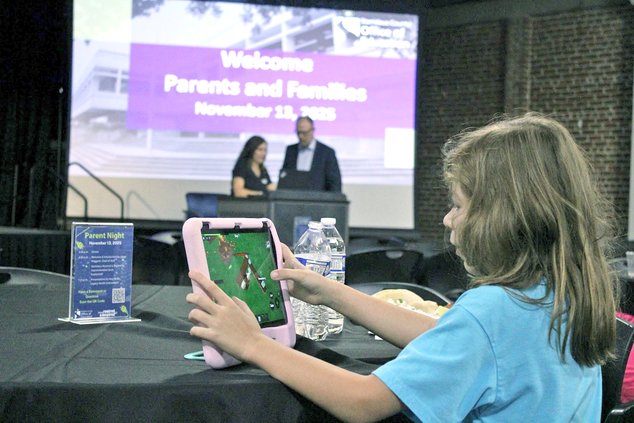
On Nov. 13, the Stanislaus Office of Education hosted one in a series of in-person programs offering a two-part lecture, dinner and resources for parents to take home.
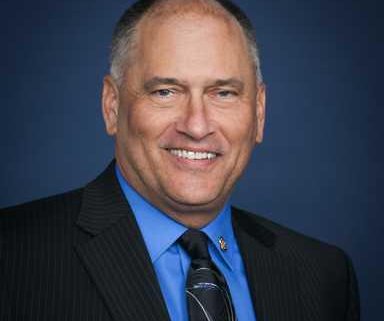
The first half offered insight into why “phone-based” childhoods are not healthy when compared to “play-based childhoods” from Scott Kuykendall, Stanislaus County superintendent of schools.
Inspired by Jonathan Haidt’s book “The Anxious Generation,” released last year, Kuykendall created the Rewired & Inspired initiative after seeing how his grandchildren were being affected by technology in ways his children weren’t.
During the event he advocated for students’ autonomy and health by asking parents to do difficult things to make sure their children learn the foundational skills needed to socialize and later build healthy relationships in their communities.
He said parents of young children should not allow screen time whatsoever for infants until age 3 and be very deliberate about the kinds of media their children have access to. He advised against the popular kid’s show CoComelon, and said it is engineered to hypnotize children and should be avoided in favor of long-form storytelling media, like movies and books.
For parents of older children, he advised them to not give students smartphones before high school and instead focus on increasing the amount of unstructured and unsupervised play time. The latter, he said, will allow children to develop problem solving skills alongside their peers.
“What we need to do is we need to give our kids opportunities to become more resilient, to become independent, to grow in confidence, right? Because what our students and our children today have very little of, is autonomy, as far as play,” he said.
Amy Wolfe, from Legacy Health Endowment, a private-foundation dedicated to serving 19 zip codes across the southern region of Stanislaus County and the northern part of Merced County, supplemented his message with applicable digital safety tips for parents.
Wolfe said social problems many students are facing today won’t originate at school, because each child likely faces challenges in their digital social life where parents can’t reach them. She walked parents through resource guides filled with knowledge she gained from speaking with schools in her area and local law enforcement.
The risks of unchecked digital social lives, she said, can range from cyberbullying to real-life exposure to local child predators in online chatrooms.
“If you are a kid who can’t find your people,” she warned, “you’re going to go find them online.”
Legacy Health Endowment compiled two resource guides for parents full of instructions on how to set parental controls on popular apps, monitor communication online and more.
Martin said these tips are probably incredibly helpful to parents who are hearing about these risks for the first time.
“I thought (the event) was gonna be more of trying to bring textbooks back, and ‘let’s limit the technology that’s going on in the schools.’ Because I have control over my child’s technology at home. I know what he’s doing. I know about this Roblox, I’m on everything,” she said, echoing some of the advice given by presenters.
“I really thought, because it’s Stanislaus Office of Education, they were going to come and bring something back to these educators and say, Hey, let’s limit this screen time (on campus),” she said.
Similar sentiments were voiced online when SCOE announced Rewired & Inspired on Facebook in September.
“Why don’t you bring back book learning?? There is no reason my six-year-old needs a chrome book!” wrote Dami Miller.
Alamar Reyna, Martin’s 13-year-old son, said while he does have more restrictions than his friends, he is still able to play games online and use TikTok as social media. It makes him a bit sad to not always be current with what they’re doing online, but ultimately he said he’s grateful for the structure he has around his technology usage.
“I have noticed that most of my friends who do have more exposure to technology actually have D’s and F’s in their grades,” he said.
Since adopting the program in September, SCOE plans to offer these resources directly to schools and community organizations after the holidays.
Savage Middle School, part of the Sylvan Union School District in Modesto said it plans to host Kuykendall in January to have a more formal introduction to Rewired & Inspired on its campus.
Sylvan is currently one of four districts supported by SCOE to promote the Rewired & Inspired program so far. In total, SCOE comprises 25 public schools ranging from pre-kindergarten to high school.
Kuykendall said that it’s good news that state lawmakers are taking a similar stance on students’ relationship with their cell phones in schools.
Charter schools, public schools and county offices of education in California will be required to pass policies to reduce student access to smartphones, and have them in place by July 2026.
“That’s a great step, and actually they’re already seeing benefits, because most of our school districts right now are piloting some type of policy that does limit students’ access to their phones,” Kuykendall said.
Downey High School on Coffee Road in Modesto has a cell phone policy with five levels of consequences for students who bring their phone out in classrooms, unless given permission by their teachers to use them.
Students will first get a warning, then a referral and call home. If they are caught for a third time, the phone is stored on campus until the end of the day. After that, students will meet with an administrator to discuss their usage. The final offense requires a parent or guardian to retrieve the phone at the end of the school day.
Denae Finney, the school’s Healthy Start coordinator said any authority overseeing students has the authority to issue the offenses. Healthy Start is a program on campus aimed to address students’ mental health through student assistant specialists.
In her department, they try not to discipline students for phone usage and instead take a more social/emotional approach to encourage them to feel safe discussing their troubles with counselors.
Finney said she doesn’t see internet addiction or exposure as too much of an issue with the students she sees.
“I can’t speak for classrooms, but I know during lunch, at least with what I see,” said Finney. “I mean, there are some kids on the phones, but I do see a lot of kids also just talking with their friends and hanging out.”
She’s waiting with her colleagues to hear more about how the Rewired & Inspired initiative develops in 2026, and how it will be used on campus.
Parents across Stanislaus County are invited by SCOE to participate in the “30X30 Challenge: Living and Learning Beyond the Screen” with their children. The challenge offers 30 ways families and children can learn things without digital technology.
The next parent night is scheduled in February, with more details to come. Learn more about Rewired & Inspired at stancoe.org.
Vivienne Aguilar is a reporter for the Modesto Focus, a project of the Central Valley Journalism Collaborative. Contact her at vivienne@cvlocaljournalism.org.