The dictates of the state of California where housing is lagging seriously behind demand and driving up costs are vastly affecting the way cities are crafting housing policy.
At the May 18 meeting, Ceres Planning Commissioners got an extensive overview of those changes being rolled into the city’s Housing Element of the General Plan.
Planning consultant Leah Simvoulakis went over the sixth cycle of the Housing Element which was adopted by the Ceres City Council on March 24, 2025. The action came late as the Housing Element covers the period of 2023 through 2031.
State law requires cities to adopt a new Housing Element every eight years. Simvoulakis said they are a huge undertaking and noted that the California Department of Housing & Community Development “really cracked down in this last cycle.” She said Ceres deserves “very big kudos” for being ahead of most cities in the county to have an adopted Housing Element.
Simvoulakis also noted she did a lot of fighting with state officials who tend to apply standards of bigger cities on smaller rural cities in the Valley.
City Attorney Nubia Goldstein chimed in that the “state has been taking a stepped-up approach and enforcement against cities who they believe are not moving their housing element approvals fast enough or implementation of the policies quickly enough.” She noted Ceres is fortunate to be on the list of cities which are in compliance at this point.
The hard part, she said, is implementing the element with the city promising to enact programs for affordable housing it promised to the state.
She noted that Ceres is in line to receive $320,000 from the Stanislaus Council of Governments (StanCOG) to be spent by Dec. 31 that would do any of the following:
- Integrate housing and climate goals;
- Accelerate infill housing development;
- Reduce vehicle miles traveled (or VMT);
- Increase housing supply and affordability levels;
- Affirmatively further fair housing;
- Facilitate the implementation of a Housing Element.
Initially Ceres told the state it was going to accomplish 33 out of 44 programs but after “a lot of back and forth with HCD … they felt that we weren’t accomplishing enough.” Once the city was finished negotiating with the state the city felt it was best to spend the money on hiring EMC Planning Group to help implement 14 of 44 programs that the city needs to implement by 2031.
Some of the changes will be accomplished by “small tweaks to our Zoning Ordinance.” The goal is to further affordable housing “by either making it easier for developers to develop, make it more cost efficient for developers to develop, with the idea that if it’s cheaper and easier, they’ll come to our city, build the housing that the community needs.”
Smaller lot sizes
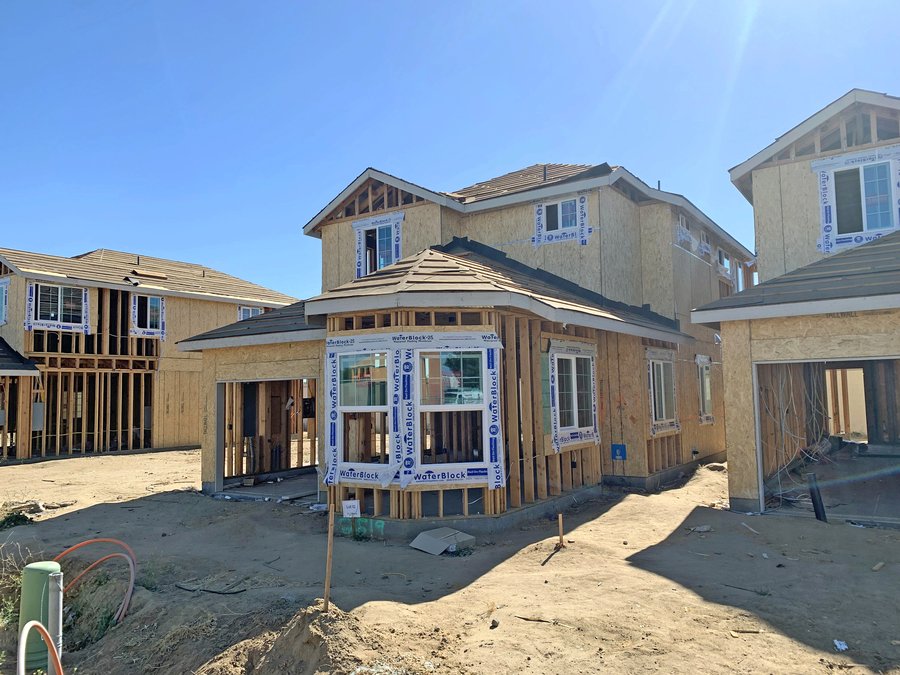
Simvoulakis is recommending Ceres adopt smaller minimum lot sizes of 5,000 square feet in the R2 district. Currently, the minimum is 6,200 square feet and for regular lots and 7,500 square feet for corner lots.
“A lot of builders are looking for 3,500 to 5,000 square foot lots. They can get more yield for the property, which encourages them to then come build.”
She noted that Ceres has lot sizes that are not consistent with current builder’s market.
Reducing lot sizes is enticing to developers since they can build more homes on the land they buy which should increase affordability.
She noted as someone who works for a private engineering firm that buyers today are less concerned with having yards but do want park space.
“Sometimes they want to go down to a one-car garage. I don’t know any city that’s allowed that yet, but we all know nobody parks in their garage. It’s just outside storage. But people, they’re building homes, and they’re selling them in Modesto, and those builders have very small lots and big houses on tiny lots and they’re selling.”
ADU changes
Ceres has a policy of allowing accessory dwelling units, often called granny flats. The city expanded the ADU program by saying 10 percent of all single-family homes built in the West Landing area must include ADUs.
“A lot of homebuilders have the option to build a new home with an in-law unit in the front or even in the back. “We have decided to make it a code requirement that all of new housing in West Landing includes an ADU.”
She said those ADUs could be for rentals, for either family members or outside individuals to increase the housing supply “Which in turns make everything more affordable.
Housing for the unhoused
One change being foisted upon local government to “make it easier to help our unhoused population transition to housing and it’s the services that they need so they can reenter into society and that is part of furthering fair housing, which is a big tenet of our housing element.”
“That doesn’t mean we’re going to be building it. Someone has to come to us to ask to build that type of unit.”
Density bonus
Since 2020, the city has had a density bonus in place but it must be updated for flexibility. She noted the city can allow greater units per acre for concessions.
“They can ask for some concessions from development laws that may make building a project difficult. For example, balconies are there an expensive part of a multifamily project. Sometimes the developer will come in and say, hey, if I can alleviate the need to build a balcony, I can get more units, and then in the end, more units for your community.”
Simvoulakis said the city will be increasing density requirements in the R-3 (multifamily) zone to 37 units per acre.
“It’s not that high, but that’s an increase from what we have today.”
Increasing density means reducing minimum parking requirements for multifamily projects, “which I know makes people nervous, but … if we reduce the parking requirements, builders can build more units.”
Simvoulakis said the state doesn’t care about concerns that folks may have with inadequate numbers of parking stalls.
“The state has all these rules that we have to follow, but then they don’t provide mass transit to the Valley which then allows people to get rid of their cars. So it’s this cycle of what comes first, the chicken or the egg.
“The state has said, ‘I don’t care about that problem. You have to just make more units, because we need affordable units in the state of California.’”
“They are telling me that I have to not park cars and make room for more units.”
She gave an example of the new parking requirements. Regardless of bedroom numbers, only 1.5 parking spaces will be required per unit in R-4, R-4 and R-5 zones.
“You will have more bedrooms than you have parking spots and those cars will probably park on the street,” said Simvoulakis.
Streamlining permit process
To make it easier on developers, the city plans to streamline the permit process by updating code to clarify the required permit types needed for multifamily residential uses and then the decision making authority.
“We’re also going to develop an easy-to-read handout that clearly illustrates the process for developers to follow. Everybody thinks the city process is scary and difficult. We want to make it as clear and concise as possible to really encourage those multifamily housing developers to come to Ceres and build the much needed multifamily housing. And the best way to do that is to have a really clear code.”
Lowering standards
The city will be increasing the height limit in some zones and removing the requirements for a wall or vegetation barrier for apartment complexes.
Simvoulakis said cinder block walls are “really expensive” which could be cost prohibitive for developers.
Another change will be allowing mobile and manufactured housing in all zones, provided they have an appropriate foundation.
“So if you would rather put a mobile home on your backyard and call it an ADU rather than build one, we’re just trying to make it easier to get housing on the ground. And these are all ace around, state mandated requirements.”
Replacement of housing policy
A new section of code will to reflect state law to require units that have been torn down to build anew to be replaced by the same number of units.
Low barrier navigation centers
State law is also requiring cities to allow by right what is termed a “low barrier navigation center,” or a temporary, service-enriched shelter designed to help homeless persons transition into permanent housing. This would mean that such a use doesn’t have to come to the Planning Commission for a conditional use permit if the county wants to build one. But she clarified the city is identifying a site inventory list where they could go.
Employee housing
Another zoning code change would allow employee housing for six or fewer persons in a single family use.
“A lot of times single-family homes have a certain definition for family and you have to be related and how many non-related people can live together, which obviously people rent out rooms that we don’t know about, but this just makes it allowable and … there’s no definition of what constitutes a family, and who can live in a single family house without it being considered a boarding house, which sometimes are restricted.”
Priority for affordable housing
In the event that Ceres is limited on water or sewer capacity, priority for hookups will be given to affordable apartment complexes over single-family housing.
Update downtown specific plan
An update of the Downtown Specific Plan will help facilitate affordable housing in downtown.
Simvoulakis noted that with the coming of an ACE train station in downtown, it’s a place where the city would like to see mixed use housing.
The changes will be reviewed formally by the commission on June 15 and then to the City Council that has ultimate authority.
Commission Chairman Gary M. Condit said that he is concerned about small parking requirement and smaller R-1 lot sizes.
Ceres resident Dave Pratt was critical of lowering minimum parking standards, citing how duplexes on Whitmore Avenue are crowded with cars.
“There’s no such thing as a two-car family anymore,” said Pratt.
Commissioner Bob Gobble reflected on zero lot line dwellings that “go to hell” in two years.
“They look really bad. They’re not kept up. You’ve got cars parked everywhere.”