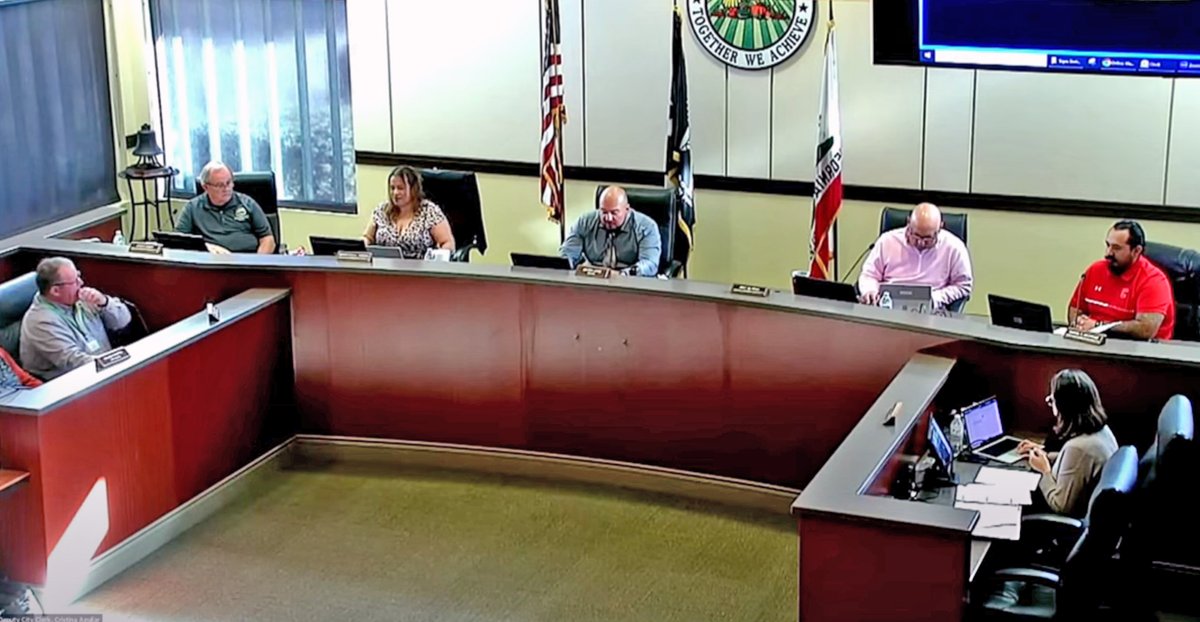
The Ceres City Council conducted a special workshop last week with City Attorney Nubia Goldstein to hammer out rules and procedures – and clarify existing ones – when conducting meetings.
The workshop, which was held Wednesday morning, Nov. 8, was a continuation of prior discussions that involved teleconferencing.
Much of the meeting focused on the “council referrals” process in which councilmembers bring up concerns or ideas they would like the whole panel to consider. Currently any councilmember can verbally ask for a topic to be discussed but the council must wait for the next meeting for it to be placed on that agenda, which is a requirement of the state’s Brown Act. At that time the council can consider if it wants to explore the referral further at a future meeting.
Mayor Javier Lopez suggested a “documented process” to ensure that referrals are not shelved or delayed.
“I don’t want there to be a referral and then – as this is nothing to you city manager at the moment – but in the past there’s been referrals that never got put on (the agenda), a month, two months went by and forgotten,” said Mayor Lopez.
Goldstein said to prevent referrals from falling through the cracks, the council could limit how many referrals can be considered, or provide a “running tab” summary of referrals made by various councilmembers and the date of the referral was made.
But Goldstein said if the current process is working then she advised not making another rule to follow.
City Manager Doug Dunford said he and his staff do track referrals but said limiting each councilmember to five referrals at any given time could mean up to 25 referrals being studied while other duties are being handled. The process of prioritizing them would need to be identified.
“I have one piece of paper right now from a councilmember with eight referrals,” said Dunford, at which time Councilwoman Rosalinda Vierra grinned and wriggled in her chair. Four of those referrals are from Vierra alone. “And so, it’s like, okay, if we’re going to say (a limit of) four, fine, then my question is how are we going to prioritize that or are you going to leave it up to staff…”
Lopez said the council should prioritize referrals.
“I don’t see it as a huge problem,” said the mayor. “I just want to make sure that councilmembers get attention.”
Goldstein suggested that the council and staff should clearly communicate as to the expectation of when the referred items will make it to a council agenda for action.
Lopez complimented Dunford on his “decently good job” in processing referrals, adding that “previous city managers have not been … it had been six months and the item never got brought back.”
Vierra complained that some of her referrals have not been acted upon, suggesting 10 have not been agendized.
“Right now I feel like they’re being completely ignored,” said Vierra, who wants the council to be informed by staff about how long it will take to prepare a staff report so the item can be presented at a meeting for discussion.
Dunford told the council that Vierra’s referrals aren’t being ignored. He said her request to consider a citywide yard sale is set for Jan. 22 agenda as well as the issue redevelopment policies. Her request to talk about initiating a Streets Team is in the process of being studied by staff but it will be back, Dunford told her.
“You have to give us time to research it, so that’s coming back to you, but that’s four you have selected,” Dunford told Vierra.
She conceded his point but noted that her issue is the delay in the process.
“It’s never hitting that second agenda to see if we can get quorum, see if this is something that we want to move forward with,” Vierra noted.
Goldstein admitted the referral process seems slow and redundant but noted the Brown Act cannot allow a councilmember to bring up an item not posted on an agenda and have a council discussion or vote to consider the referral. The matter must come up at a second meeting and be posted on the agenda.
The council also focused on how much time to allow the public to speak at council meetings. Lopez’s three-minute time limit proposal was shot down.
Currently members of the public may speak up to five minutes during “Citizens Communications” but Mayor Lopez suggested a limit of three minutes in keeping with what other local city councils offer “especially when you have 10 folks talking on the same subject.”
Lopez wanted the council to give him “the responsibility to dictate that because there might be times where you have a lot of folks, (and) there might be times when you have one person and we might just allow that person to speak a little over the allotted time.”
Goldstein said the council must be consistent in its time limits. Thus, if the mayor extends a longer time for one person to speak, he must do so for everyone, she said. Likewise if the room is packed with folks wanting to address a hot button topic the council may shorten the time they can speak but the rule applies to all.
Vice Mayor Bret Silveira wanted no changes to the policy, saying “we seldom have a problem with so many speakers that we shouldn’t limit them to three minutes.” Councilman Daniel Martinez and Councilwoman Vierra agreed also opposed the three-minute limit for the public.
The exception to the time limit is when project applicants are appealing a prior council decision and they can speak for up to 10 minutes. Also, the time limit does not apply to those giving presentations or staff reports.
Goldstein said that in the event of a packed house, the mayor could decrease the number of minutes for all speakers from the public by a vote early in the meeting. But Silveira rejected that idea, reiterating that he doesn’t want citizens limited to three minutes “at any point,” adding “our citizens have a very few opportunities to speak to us and I think we should give them those full opportunities.”
Toward the end of the meeting, the council addressed Chapter 5 on Boards, Commissions and Committees.
Vierra expressed concern about one city committee member – which she didn’t identify – who declared a conflict of interest yet participated in discussions and “became very argumentative with anyone that came against their position even though they already declared a conflict.”
Goldstein said the incidence Vierra was referring to occurred on an ad hoc committee which is still subject to all the rules the council must follow “so if you’ve basically declared a conflict you really shouldn’t be participating and you need to step out of the room.”
Councilwoman Vierra also noted that a lot of Planning Commission meetings were cancelled over the summer due the lack of a quorum of three members because of vacation absences.
The council may set the attendance rules for committees, said Goldstein, who understood that state law considers anyone who has missed at least 60 days with unexcused absences to be vacating the seat.
The city attorney stated that the council may remove a planning commissioner for any reason at the majority’s discretion, but specifically can remove any Planning Commissioner who misses two consecutive meetings unless those absences are excused or if the member is ill.
Martinez suggested that a representative of the city attorney’s office be present at committee meetings to answer legal questions when discussing changes to city ordinances. He cited how the committee looking into mobile food vendors as an example had questions but no attorney present.
Vice Mayor Bret Silveira brought up the recent meeting whereby the council nearly reappointed Planning Commissioner R.J. Jammu without first seeking applications from the general public. He said the Council Handbook calls for the city to announce a vacancy at a council meeting and call for applications. Silveira said he didn’t know about the process until he read it following the meeting.
During the workshop Mayor Lopez said he has been allowing elected officials or their representative to speak at the dais during “Citizens Communications” at the outset rather than have them wait to speak at the very end. Some, he said, have opted to stay anyway because of their interest in the proceedings.