By KRISTINA HACKER AND JOE CORTEZ
Staff reporters of the Ceres (Calif.) Courier
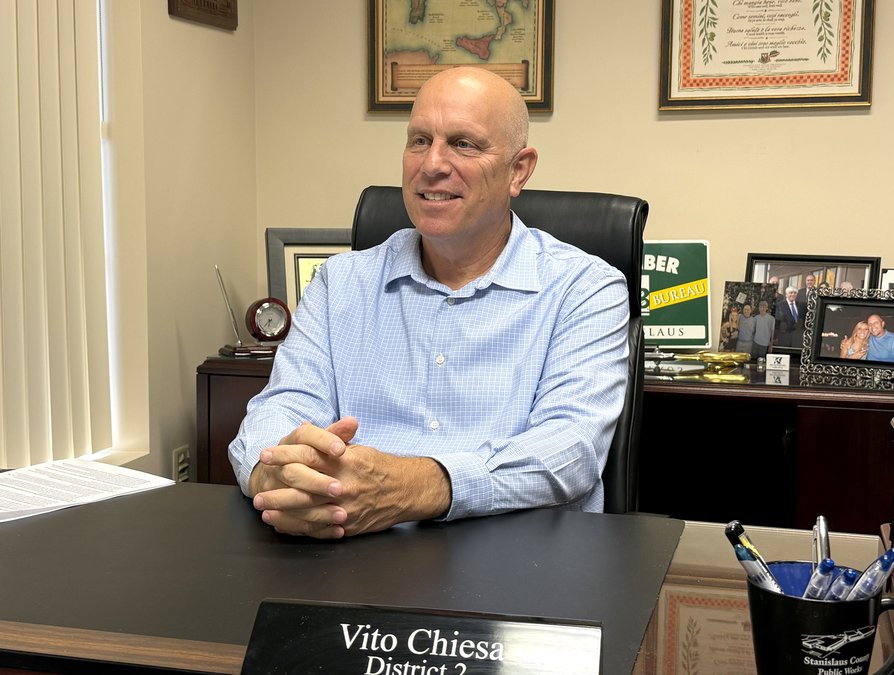
Recently Stanislaus County District 2 Supervisor and Board Chairman Vito Chiesa sat down with this newspaper to talk about a number of issues. He talked about his State of the County address — which was set for yesterday — along with updates on the county’s ARPA spending, the state’s rail plan, the county’s mental health plan and more.
Q: Let’s start with an update on the county’s ARPA (American Rescue Plan Act) funding.
Chiesa: “So, we had what I consider a once-in-a-lifetime amount of money – $107 million – come to the county, really through COVID, and so we took an introspective look. If you remember, we put some money toward a Brookings Institute study. We were a partial funder of that, and some of Stanislaus 2030 came out of that. I can talk about that in a bit, but we’ve got more than 40 legacy islands inside the county. You’re probably familiar, being from Turlock, with the Kenwood Island, which is Mitchell and Kenwood roads just north of Canal. They’re county islands that don’t receive any services from the city; they’re typically on septic (tanks), and they have wells. … We had determined that we were going to try and fix some of the county islands and get the cities to incorporate them, which would bring much better services to the residents there.
It’s very difficult for the sheriff’s department to drive from outside, say, Hickman, all the way into the middle of Turlock to respond when Turlock could respond quicker. So, Kenwood Island is one of them. Topeka-Kansas is in District 1, which is in the Riverbank area. Similar, they’re working on Colorado-Rouse, which is over by Modern Woodmen Field (formerly John Thurman Field); Riverdale Track, which is in Terry Withrow’s district, District 3, the west side of Carpenter; and then Parklawn and a couple of other smaller areas. But the majority of the county islands, the biggest ones, are in West Modesto. So, we split up the ARPA funds; we took $50 million and set it aside out of the $107 million and we divvied it proportionately to fix all of the county islands and bring them up to a city standard. It was about three-quarters of a billion dollars, so we’re still a long way away. We did add $15 million of discretionary spending to the actual $50 million, plus Sen. Marie Alvarado Gill gave us $5 million in essentially an earmark request, so we can actually attack some of these issues. They’re all under construction in some form, or they’ve been bid out and we’re about ready to start construction. Kenwood’s one of the last in my district on which they’ve opened the bids. It’s come in about where we thought it was going to be, which is a good sign. And you should see it be under construction this fall. It’s not enough, obviously, to do it all, but we’re making a difference with what we consider the most impacted areas.
So, that’s $50 million of (the ARPA funds); $30 million we put into economic development, and that’s very broad, but that’s where the Brookings Institute comes around. They identified that this is one of the best places in the United States, let alone the world, for a bio-circular economy. We have so much ag, I don’t want to call it refuse, because that’s not the right word …
Q: Byproducts?
VC: (Nods) Byproducts. We’re kind of the mecca for tomato processing here; we did have Del Monte until recently. But you have all of that and we just spread back out in the field and incorporate it back in the soil. We’ve got bio-mass coming out of orchard removals that we can’t burn anymore. There are no co-generation plants where they burn it to create electricity. And so we started looking into that, and we thought, “here’s a place we could target.” That’s where Beam Circular was started. We had seed money of about $10 million that we put into that project, and it’s amazing how they’ve turned the seed money into an expansion, because this is something that everyone can get on board with. If we can make it happen, you’re upscaling what is now currently just material you put back in the field. There’s nothing wrong with putting something back in the field, because you’re still building up the soil; you have the ability to do carbon sequesterization naturally, maybe less fertilizer, better water-holding capacity. But is that the single greatest use? Can we upscale everything that we consider byproducts? There’s some value in it now, but it’s very little value. And then there’s also the risk ratio that almond hulls are used for cattle feed. It’s a great protein source, and it’s reasonably priced. If you were to find something that made it worth $1,000 that’d be better for the farmer, but it may not be better for the dairyman, and so you’re trying to find things that have less value and try and upscale them, and walnut shells would be great. Right now, we’re using walnut shell for dust control. It’s great for that, but there’s probably a better use for material like that. So, the partnerships that Beam Circular has created are truly amazing. …
We put some money in various other areas. One of them was child care, which is a part of our economic development. The Brookings study showed there’s a need of 12,000 daycare slots in this county.
Q: Did you say 12,000?
VC: (Nods) So, we put some money toward that. If you want people to be able to go to work, child care is one of the huge impediments in front of them. We were lucky enough to get involved with a group out of Merced, which had a pretty good code that they had cracked on how to start these businesses; and they are businesses. They help them through the system, and then they are given a grant; and that’s the seed money that we’ve given to secure their home to have kids there.
Also, part of the economic development portion of that went out to putting in a water system at Crows Landing, as we start to prepare that. There has to be some infrastructure if you’re going to try and market it, and we need potable water. We’re putting in a well next to the community of Crows Landing, which has lots of water issues in its community service district, so it will be cross contained and we can pump water that way. If necessary, we’ll have potable water for the first phase, and that’s been a long time coming. As long as I’ve been sitting on the board (since 2009), we’ve been trying to figure out exactly how to take care of that.
Q: The Bee recently quoted you as saying that you are “as disappointed as anyone” regarding the new delays facing the ACE rail expansion. What is the adjusted timeline for bringing commuter rail to Stanislaus County?
Chiesa: So, I’m a board member on the Amtrak of the San Joaquin. I’m not an ACE board member. People see me as an ACE board member because I’m so closely aligned; the same management manages both of them. What I’m on is the Stations Development Committee, which has two board members from the San Joaquin and two board members from ACE, and has been tasked with trying to figure out the state rail plan, how we fit in the state rail plan, and where we go first on a limited amount of money.
When I said I’m as disappointed as anyone, I was a party to making some of those decisions to go north before we come from the south, and the subdivision line that we’re going to use to get to Sacramento to go to the north, north of Stockton, is the lightly used Union Pacific Railroad line, so there’s not a lot of impacts. It’s along the I-5 corridor and you can build a station along I-5 and Lodi; you can build one in Elk Grove. It’s easy, because it’s cattle ground, and it’s right outside of town. I hate to use simple words like that, but it’s easier than when you’re trying to build a downtown Modesto station. You’ve got the Kinder Morgan gas line underneath, you’ve got fiber-optic cable; it’s impacted to build two of them because we have to go to a center-loaded platform and it creates lots of issues. Ceres is going to be right under the Whitmore overpass, and that’s a very impacted area with not a lot of space. Turlock would probably be the easiest of the three stops expected in Stanislaus County, but that’s the next phase; we have to get to Ceres first. So, when you look at all things – where can we build and get service running quicker? – the preponderance of the evidence leads you to going north. There’s also more ridership going north.
There’s about $250 million that came through (former state Sen.) Anthony Cannella’s bill, originally of the $400 million that can only be spent between Lathrop and Ceres. So, nothing is stopping, but there’s not enough money to complete it. But going north, starting to build stations, and running some service – because the line is less impacted than down here in the Modesto area – is the way we went.
We have to do what I’ve seen happen in Highway 132, in the North County Corridor. In 1960, they started buying right away, and it wasn’t until we passed Measure L in 2016 that gave us the match money to apply. Once we were successful on the first phase, the second phase is fully funded already. So, 1962 to 2024 … and it was opened 2026. We’re going to start construction on the next phase, North County Corridor, which was a dream when I got on the board.
Q: So, when I ask you, when can we see light rail commuter trains in the county, what would your answer be …?
Chiesa: You can currently drive over to Denair, and you can get on a train right now. You can get to Stockton, and you can get on ACE and head down to get to the Bay Area, San Joaquin ends up in Oakland; San Joaquin Amtrak goes from Kern County to Oakland, and then two trains go up to Sacramento. Currently, ACE runs five trains a day, I think, from Stockton to San Jose. You may have to take a quick Uber from the Amtrak station to go to San Jose, and you’ve got to go over to the Stockton Cabral station, but that’s two miles, and you can actually get on a train. What we’re trying to do is make it more convenient, where people can do cross-platform. If I ever show you the state rail plan, Stanislaus County is the big winner if high speed rail ever makes it to Madera; Merced would be better, but Madera for sure. The reason Merced is more important is that you have ACE train on this line (gestures with left hand) and Amtrak over here (gestures with right hand). Amtrak is currently running six trains, so that’s not hourly service, that’s every two hours. Then, you start running ACE trains every other hour and you have hourly service to get to anywhere. You go right, you go left, you go right, you go left – you’ll get there. And there’s going to be an Natomas stop on ACE and Amtrak, because both of them are going to use the same downtown Sacramento stop, and that one’s practically already done. There’s not much that has to be done. It’s going to be essentially a whistle stop, and then a stop in Natomas into the line, and you’re going to make it to the Sacramento airport, so there’s lots of really, really good things. Money is the key. Cost of construction after COVID has exploded the cost of all projects, not just the rail projects. And so, we had to prioritize.
Long-winded answer, I know.
Q: The supervisors recently approved the new mental health plan that addresses the state goals, which included access to care, reductions, homelessness, judicial involvement, children, etc. You noted the public pushback against new behavioral health facilities like the Alamo Health facility on Colorado Avenue in Turlock. How can the county bridge the gap between providing state-mandated mental health housing and addressing those safety concerns?
Vito Chiesa: So, first of all, this was voter-approved. I just want the public to understand that this went on the ballot to change the paradigm of how the county deals with services. It’s not bad, because there’s an accountability that there never was before. We used to write numbers – how many people we treated – and we would farm a lot of it out. Now, we’re going to be responsible for the outcomes. Accountability is something that’s been lacking in the system. But again, it’s a paradigm shift. We’re going to have to do a lot more reporting, so we’re actually hiring statistician-type folks who are going to have to track all of this, and it’s making us do more. Referring back to what was Las Palmas, which is now Alamo, it’s our job as a county to make sure who gets sited there. … I think people will come to accept it, because if you have someone on the street having a mental health breakdown, whether they’re in a neighborhood or in an industrial complex, I think most people would say it’s better to have them housed where they can receive their medication and treatment. I think it’s more about having a dialog with the community, and not putting too many people – like, hundreds of people – in one spot. If you have a low-barrier shelter, there are fewer locations to site something like that. … We’ve got a couple hundred people over here on Ninth Street (in Modesto), and that might be too big, but again I’m excited from an accountability standpoint because we never could tell exactly how we were doing. We saw 1,000 people, and we say that’s good, and this year we saw 1,100 people, so things must be better. Well, that’s not always the case.
How many people did you move out of the low barrier shelter into some stable housing like Dignity Village (in Modesto), receiving treatment? And then, how long did they stay there before we got them into the Kansas House? And you’re moving them through the system to become independent, not to be reliant just on the county.
Q: Stanislaus County cut nearly 150 allocated government positions from its budget in March. What core public services are most at risk of experiencing slower response times or reduced availability?
Chiesa: So, I don’t want to talk about just one department, because I think that this is going to affect all departments on a go-forward basis. We’ve had so many good years coming out of 2009, ’10, ’11, which were not good at all. In 2012, things kind of bottomed out, and since then – 2013 through 2025 – we’ve pretty much seen an increase in our budget, sales tax receipts, property tax receipts, everything. And now, the economy has softened; property tax is flat; sales tax is flat; and we’ve instructed most of our departments to take a look at what are their core services and start the exercise of what it would look like if they were 3 percent or 5 percent down. I think this is the beginning of a slowing of government. The preparation for 2009 wasn’t there. It was so quick and cataclysmic, for lack of a better word, and our reserve levels weren’t where they are today. The good news for Stanislaus County is that we’ve had 12 years of thinking about what it might look like if it happened again, and we’re more prepared with our reserve level. So, I think we will hold open positions. I don’t know that there’s going to be a bunch of live bodies that would lose their job because I think we can kind of coast over the top, but I won’t be surprised if things don’t improve a little bit. We have a no backfill policy here at the county. If the state or the federal government cuts a program, we cut the program. It’s pretty simple. We don’t run off of our limited $320 million discretionary spending; we don’t pull out of that pot to run a program that’s out of the $1.9 billion budget, because it would be defunct in a matter of a year or two. So, you see, HR1, The Big Beautiful Bill, has some good things in it, it’s got some not so good things for the county. There are cuts on the Medicaid side. And it’ll have downstream effects on county services. I count on the smart employees to let us know, but I think there’ll be some tough times ahead based on state and federal funding.
Q: Stanislaus County Sheriff Jeff Dirkse has spearheaded an effort to transition the department’s emergency dispatch, records-management, and jail-management systems to a new one developed with Oracle. The push has led to disputes with the Board of Supervisors and the county’s primary 911 dispatch agency. What is the status of the transition to Oracle?
Chiesa: So, I can’t tell you about the program itself. You’d have to talk to Jeff. What I can tell you is that the executive level of the county, the executive level at Modesto, as well as the sheriff, have had conversations on potential paths that they’re studying, and that’s fairly recent. That’s what I know on where it stands right now … today. The board had certain qualifications back in March of 2025; a letter was sent to Jeff Dirkse noting things that we wanted to see before they implement. … It’s my job as a supervisor to the taxpayers of Stanislaus County to make sure we’re spending our money as efficiently and effectively as possible. … I personally don’t support anything that I consider degrading the system. The system of dispatch is CAD [computer-aided dispatch] to CAD working together, so that you don’t call and have to repeat things to the call-taker, to the dispatcher of fire, the dispatcher of ambulance, the dispatcher of police services; that the system works together as best as possible. I know we have that today, and I don’t want to degrade it from that. We only want to enhance the program, and if you can enhance the program, then the taxpayers probably could pay more money. I don’t know if we’re at that point yet, but it clearly states in the letter what, essentially, the hierarchy of needs are. I think that the sheriff wants Oracle. I think he’s going to get Oracle. Is it going to be a standalone, which doesn’t make a lot of sense; or is it in conjunction with our partner agencies, where we share call-takers, and that the system, the two CADs, work together rather than being completely separate?
Q: You’re not up for re-election for another two years, so we’ll spare you the usual questions about your intentions to run again. But I’m curious, what led to your original decision, many moons ago, to get into politics?
Chiesa: Stanislaus County Farm Bureau … I became a board member, and it’s as simple as that. It really made an impact on me. It gave me the opportunity to step up into leadership and then do lobbying in Sacramento. And then I was put on the state Farm Bureau board representing Tuolumne and Stanislaus counties. Then I ended up in D.C. to talk about the tractor tax revision. We were one of only two states that had a tax on tractors. Then GS West brought to my attention that there was a tax on propane, which is the primary heating source for unincorporated residents and farmworkers. It was unfair because natural gas wasn’t taxed, so that was included in the bill, and a few other things. And I saw that we could make a difference, as farmers, when we banded together for a common cause; that’s rarer than you think, for farmers or anybody. So, it was through the Farm Bureau organization that my interests were piqued. I felt empowered to make a difference and felt I could make a difference. I think supervisor is really the one area in which you can effectuate change within the ag community. And I was lucky enough to be elected.