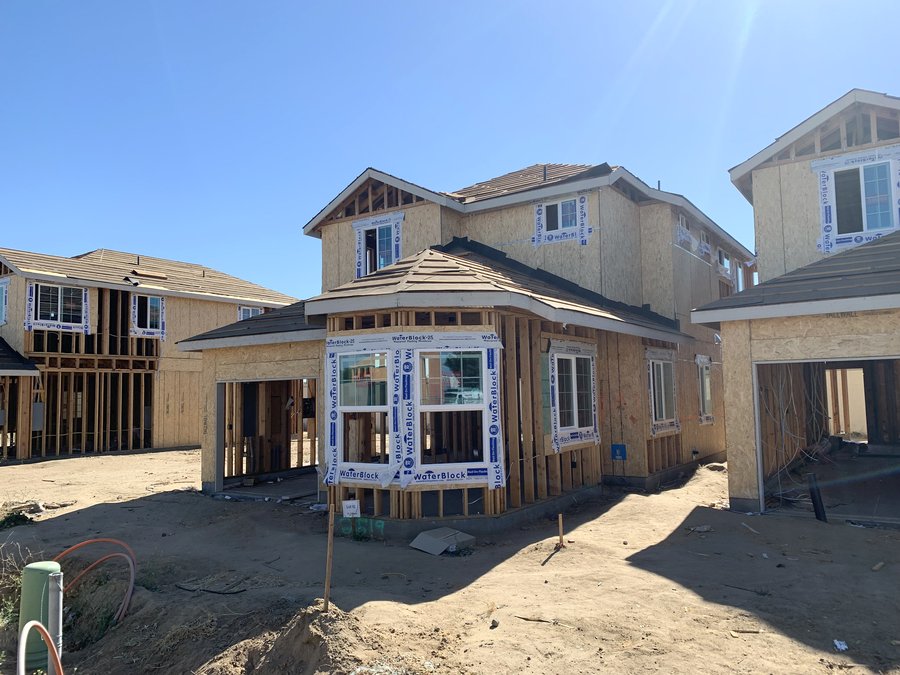
Changes are being made to the housing policy in Ceres because of mandates from state lawmakers aimed to encourage the building of residential units in the state.
Last week the council took action to implement the Housing Element adopted in March. Planning consultant Leah Simvoulakis reviewed the sixth cycle of the Housing Element which covers the period of 2023 through 2031.
Ceres became the third city in Stanislaus County to adopt a Housing Element which city officials heralded as an accomplishment considering how onerous the state has become to enforcing dictates from lawmakers.
Adopting a housing plan is one thing but making it become a reality is up to the private sector to build new units.
Later in the year the city will have to ensure that its Downtown Specific Plan aligns with the new Housing Element.
Kylie Pope a senior planner with EMC, the consulting firm that crafted the Housing Element, went over some of the updates.
The city is adopting smaller minimum lot sizes of 5,000 square feet in the R2 district. Currently, the minimum is 6,200 square feet for regular lots and 7,500 square feet for corner lots. Simvoulakis said most builders are looking for 3,500 to 5,000 square foot lots to squeeze more units out of a site, which the state desires. Reducing lot sizes is enticing to developers since they can build more homes on the land they buy which should increase affordability.
Changes also include establishing minimum densities in multifamily districts, increasing allowable lot coverage, reducing front-yard setbacks and parking requirements, prohibiting single family homes being built in multifamily zoning districts, and removing certain development standards that may unnecessarily constrain multifamily development.
A cleanup amendment is being added to increase the maximum building height in the R-3 and R-5 residential zones from 35 feet to 40 feet.
“These changes again are intended to remove development constraints while supporting residential densities contemplated in the Housing Element,” said Pope.
Parking standards for apartment complexes are also changing to make parking tighter for the sake of increased densities.
Pope talked about the challenges of balancing “the amount of land devoted to parking with the number of residential units needed to make a project financially feasible. So surface parking lots, they consume a lot of significant developable land and can substantially reduce the number of units that can be built on a site. Then you have structured or underground parking, which can help preserve unit count. But those facilities are typically very expensive to construct and so they can significantly increase the overall development costs. So as a result, the state has increasingly moved toward limiting or reducing local parking requirements through recent housing legislation.”
Simvoulakis commented that “parking is always a hot button with the community.”
“Unfortunately, it’s always those who have the luxury of housing that oppose reduced parking standards,” she said. “I think that if you ask our population struggling with housing, they would rather be housed than have a place for their vehicle. The streets are public to park on. So in order to get more units on a housing site we need to see smaller parking numbers.”
Simvoulakis also admitted that “really the only way to encourage other transit methods is to make driving uncomfortable, parking uncomfortable so it’s a small step toward the larger aim.”
Changes also include protections for the development of Accessory Dwelling Units (ADUs for granny flats), supportive housing, employee housing, emergency shelters, low barrier navigation centers and residential care facilities. In many cases, state law requires these housing types to be permitted similarly to other residential uses or requires that local regulations not impose unnecessary barriers to their development.
“And so, for example, for residential care facilities, under the proposed amendment, the city would allow them in all residential zones and treat them the same as other residential uses at the same time. So what that means is in a single family zone, a residential care facility would be subject to the same standards as a single family home. And if it were in a multifamily zone, it’d be treated like a multifamily use. And the goal here is to ensure that these facilities are permitted objectively and consistently without any additional or unique requirements.”
Changes in the law also protect those who wish to build group homes in R-1 zones from neighboring property owners who might oppose the resulting design feature or accommodation that’s being requested by the applicant. She gave the example of a wheelchair ramp which is considered a reasonable accommodation.
Simvoulakis noted that once development takes off in the West Landing Annexation area, at least 10 percent of the single-family homes must be built with ADUs.
Another significant change is the city is adopting ordinance language to require replacement housing.
“It establishes that the city cannot approve or issue a building permit for a housing development project that would demolish an existing residential use unless the demolished units were replaced in accordance with state replacement housing requirements,” said Pope. “So the state is just making sure that there is a one-to-one replacement ratio; that we’re not taking down a multifamily or a duplex or triplex housing unit down to build a single family.”
Another change gives priority to developers who wish to build affordable housing units when water or sewer capacity is limited.
Since 2020, the city has had a density bonus in place but it must be updated for flexibility. She noted the city can allow greater units per acre for concessions.
Simvoulakis noted that the state Housing and Community Development (HCD) agency is watching even the smaller cities to ensure state dictates are being followed and noted that at least one city in Stanislaus County, Turlock, is being sued for being out of compliance.
Councilwoman Cerina Otero said while the housing shortage is real in California, growth means cities forced to deal with infrastructure needs.
“It’s frustrating,” opined Otero, “how much control the state has over our cities and not giving local government any control on these policies. They just come up with something and it’s like, ‘yep, here you go, now you have to implement it. Now you have to change your ordinance.’ I think that as local government, we know what’s best for our city. So I would hope that … we could push back on a little bit that does not benefit our city.”
Vice Mayor Daniel Martinez said Ceres needs housing and that he was proud in 2021 as a member of the Planning Commission to approve Whitmore Ranch.
“It was supposed to be multiple phases of multiple homes being built and that never came to fruition,” said Martinez. “So anything we can do to get in line with HCD and maybe entice more builders to come to Ceres and build for our community I would definitely support.”
Councilman James Casey sought clarification on a provision that would allow manufactured mobile home units to be placed in R-1 zones with a foundation.
Casey and Otero cast votes against the Housing Element implementation but it passed 3-2.