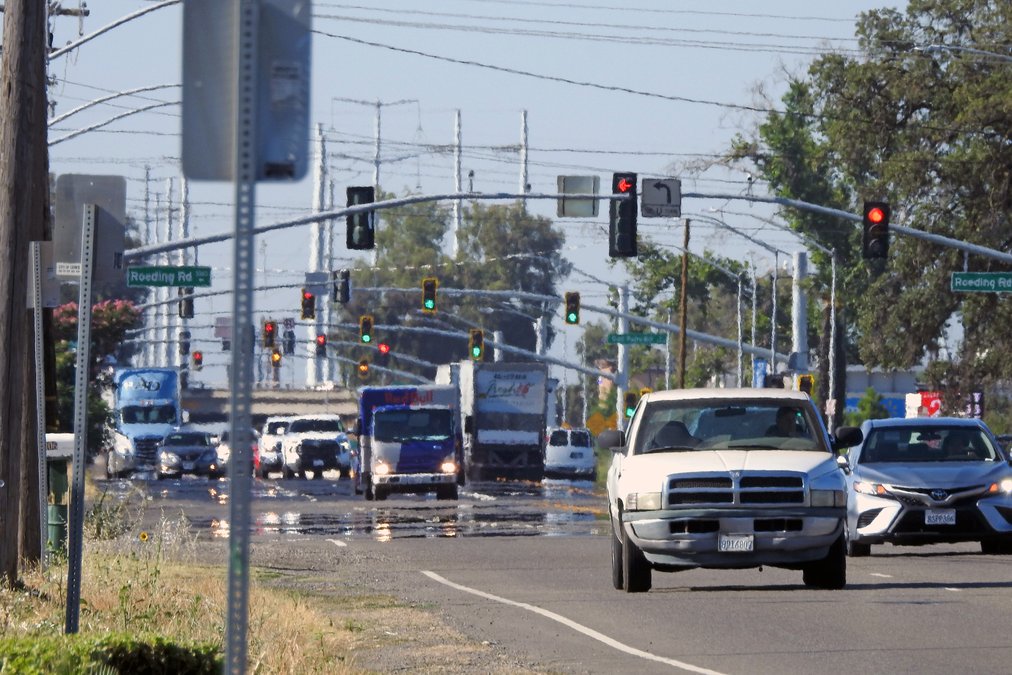
The Ceres City Council last week voted to approve a $1.9 million contract with a firm to modernize traffic detection and intersection monitoring capabilities.
The move to contract with AM Signal, LLC, is considered to be the final major component of the city’s traffic signal modernization effort and will provide advanced traffic detection and real-time intersection monitoring throughout the network.
The proposed project consists of two integrated components: Installation of Miovision advanced video detection systems at all 39 signalized intersections in Ceres; and installation of high-definition CCTV cameras at 20 key intersections.
The goal is to make for a more efficient traffic flow in Ceres and eliminate a hodgepodge of technologies currently in use.
“This actually includes all of the video detection at every one of our signals,” said City Engineer Michael Beltran. “Currently right now, we have some intersections that have cameras, some intersections that have loops, which are in the ground. Some intersections don’t have either. They’re just on timed responses. So, the video detection included in this will be a wholesale upgrade of our entire traffic system throughout the city.”
He said the contract covers installation of the controllers and the switches, and the timing “which will be traffic synchronization along our major corridors.
“Traffic synchronization is something that we have been working on. It has to do with the timing of those signals to make sure that during peak hours, so generally in these 6:30 to 8:30 range. We are looking at the lunch peak hour to see those traffic volumes, but we could have the lunch hour in there. And then in the evening, peak hour is usually about 4:30 to 6 p.m. on where you will have traffic synchronization throughout these corridors.”
Even with traffic synchronization, Beltran said the system will have to be constantly adjusted.
Also part of the work is installing surveillance cameras at 20 intersections not presently covered. He noted that as far as the Engineering Department is concerned, Avigilon cameras will be used to monitor traffic but that no recording will be done at City Hall. Instead, only police have the ability to record what cameras pick up.
“Our traffic engineer will be able to monitor the traffic, but no recording will happen in the Engineering Department,” Beltran stated. “That’s reserved for police and their investigative purposes.”
Mayor Javier Lopez said the contract is a “very exciting investment moving forward for the city of Ceres. This project has potential to be a real game changer here in our community.”
The technology will allow the system to respond to what it sees in the field, said Beltran, such a pedestrian in a wheelchair that needs extended time to cross a street.
It’s also intended to not make someone wait longer for a green light if cross traffic allows instead of the timed system.
“If you pull up to an intersection at 9 o’clock at night and there’s nobody there, it should start cycling so that it can get move you through the intersection,” said Beltran. “So those types of things will be improvements that everybody sees within the community.”
But he said traffic engineering is “not a perfect science by any stretch of the means,” but the new system will allow for lights to be controlled remotely.
“It can alert us if there’s some sort of outage. So all of those types of things actually come with this new upgrade.”
Synchronization can get interrupted by pedestrians pushing walk buttons but will return in two to three cycles.
“But for the most part, synchronization is really based on the speed that traffic is moving, so racing to the next light generally gets you caught at the next light. In synchronization, if you go the speed limit you should generally hit those lights, provided it isn’t a peak hour.”
“I’m supportive of this investment,” noted the mayor, “because it moves our infrastructure and public safety capabilities into the future. Twenty real-time cameras can improve coordinating among engineering, public works, police, and fire, which is very important. As we prepare for the future, I also want this system designed so it can eventually support a real time crime center.”
Funding for the project is from Measure L funds, the countywide half-cent sales tax measure.
Beltran said installation will likely occur sometime around the beginning of next year. There will be brief disruptions during the installation with stop signs posted at signalized intersections.
Chief Trenton Johnson said the city does not use flock cameras and noted there is a policy in place that cameras cannot used for personal issue and violations would result in discipline.
“We don’t use it for any facial recognition, even though I think that is a capability.”