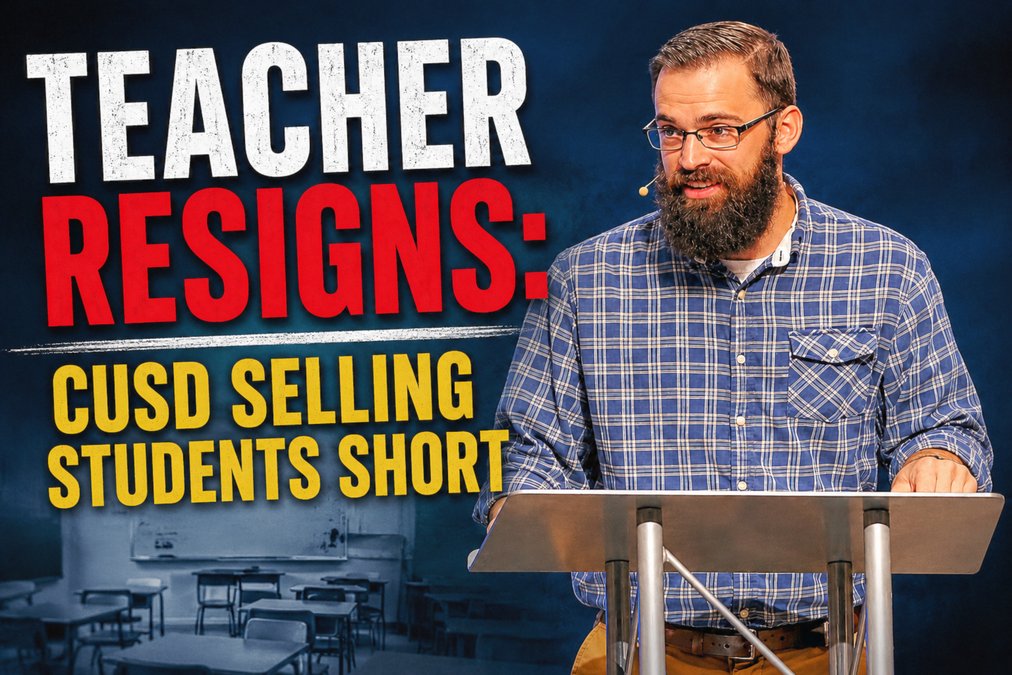
Daniel Fox has walked away from eight years of teaching for the Ceres Unified School District, citing a deep philosophical divide in its approach to grading and disillusioned over an education ideology that he says is to the detriment of students.
”I’ve have been burned out of the public school system,” Fox told the Courier during the last week of the school year. “I’m done. Nobody’s forcing me out. I’m leaving.”
Fox, who taught English at Central Valley High School with two master’s degrees under his belt, claims the district continues to hold onto COVID era policies that other districts have abandoned.
“I’ve had conversations with the admin at various levels, and have been relatively jovial in terms of, like, this is a difference in ideology,” said Fox, “but I do feel it’s dire.”
“My school just got named recently as, I think, the top school in the Central Valley, the Modesto Bee named them and I disagree.”
Specifically Fox said schools enacted a policy during COVID to “make sure kids weren’t unfairly failing over distance learning,” which he considered a fair concept at the time. But he said CUSD holds onto a policy that teachers cannot grade homework and said “in a lot of places, you can assign it, but you can’t grade it at all.”
Fox said he believes the district has good intentions but doesn’t believe the system is working.
Students ‘getting burned’
“I think in COVID we tried to protect the kids by putting a bunch of rocks around them to protect them,” said Fox, using allegorical term. “But I told them, one of those rocks was a dragon egg and it’s hatched and it’s burning everything. And I think that’s these grading policies, these no homework policies and these ‘reading is only for a skill’ policies.”
Paul Rutishauser, CUSD’s Assistant Supt. of Educational Services, said “the policy has never been ‘no homework.’ The training has been if you’re going to give homework, then there’s some things you need to think about. Like, for example …is it valuable for them?”
He said the district has tried to steer teachers away from giving homework as “busy work” as a way of “bolstering grades and make it easier for students to pass the class.”
“We’re saying, don’t do that. Instead, give the weightier, meatier assignments and just focus on those. So that’s the spirit of what we’re trying to do.”
“It (homework) should be meaningful and tied to learning,” said Rita Menezes, CUSD’s Director of Secondary Education. “Kids can be able to perform well on the homework without their teacher present, but there’s never been anything that says, you can’t give homework. We have challenged teachers to rethink what they assign as homework and sometimes that’s uncomfortable.”
What kinds of homework does the district feel homework is unproductive? Menezes gave an example of “an arts and crafts project that’s not necessarily tied to learning, but more tied to, like make a mural about something, but then there’s nothing substantive that’s tied to actually mastering any kind of content.
“And then a lot of times, a student’s low performance might be due to a lack of resources. So the kid with a prettier picture ends up getting the better grade, whereas the kid, who does, isn’t artistic or doesn’t have the resources at home to make a pretty picture, doesn’t get a good grade.”
What kind of homework is expected then? According to Rutishauser, research on homework says that it’s “more effective for older kids than for younger kids and that it’s more effective that the student has already learned the skill and their practicing it. In other words, they’re moving a skill into long term memory.”
Grading scales changed
Fox stated that CUSD enacted its new grading scales during COVID which remain in place but have been dropped by other districts.
“You cannot give kids a zero,” said Fox. “So the only appropriate letter grade that is possible is a 50. So if the student doesn’t turn an assignment, teachers are required to give a 50 percent, which I have a problem with because that’s lying.”
Fox, a Christian who was a youth worker before coming to CUSD, said he was disciplined last year, investigated and reprimanded for using a 0 to 100 grading system. And his argument was, “I don’t want to lie to parents. It goes against my religion.”
Fox said teachers were given three options for grading:
- One where a student who earns 0 to 49% is entered as 50% instead;
- A grading scale which is divided into four equal ranges rather than the traditional A/B/C/D/F percentages so that a 12.5 percent is passing;
- Equal intervals of 20, 40, 60, 80 and 100 percent that allows passing at 20 percent (which traditionally would be an F grade).
The debate about grading centers on whether the traditional 0 to 100 percentage scale gives too much weight to failing grades, since an F occupies 60 percentage points while every passing letter grade occupies only 10 points. Equal-interval scales or minimum-score policies attempt to reduce that imbalance, though critics like Fox argue they may make it easier to pass without demonstrating sufficient mastery.
Expecting less?
Without naming names, Fox said several district officials have explicitly referred to the impoverished nature of Ceres as the reason for changing the grading system. He feels that’s discriminatory and undercuts the education of students in Ceres.
Fox believes holding kids accountable with grades they deserve motivates them to do better and study harder. The lax grading system, he feels, is “robbing them” and is what keeps them from rising and lifting out of poverty. He noted that 81 percent of CUSD students are of Hispanic origin and 85 percent on free or reduced lunches.
After sharing with one district official – he would not name – about how students were soaring after he challenged them to read books to connect with the humanity of characters, Fox was interrupted with the question: “Were they able to connect it with their poverty?”
“And so the stated reason that they have been changing these things is because the community is poor. And that I can’t get behind, because that’s the only way to keep them bored if you’re gonna lower the standards and pass them along.”
Fox said he suspects the direction is coming from the board level.
“They do have the best intentions. I think that what we have is a bunch of different philosophies that are stuck together with glitter and glue. And my worry with this is that it just creates a bunch of ‘hey, I checked off that skill, now I’m good; I checked off that box, now I’m good’ without actually learning it. Something’s not working.”
Traditional grading debated
According to Rutishauser, educational research has shown that traditional grading where anything below a 60 percent is an “F” grade is “really built for very surface level knowledge.” Abandoning that style of grading, he said, is “about making the ‘A’ range.” The reason for the grading change, is built around the idea “that if a student messes up, they can recover.
“The district understands that students get F’s. We don’t like it. We think we should be supporting students so they don’t get F’s. But students will get F’s, and that’s okay.”
“In no way should making the A, B, C, D, F equal percentages or equal distance, in no way should that mean you have to water down your expectations. In fact, you should be able to even raise your expectations to make sure that students are actually performing at a level that gives them an A or B.”
AI essay cheating?
Fox also has argued that the district’s push for student use of Chromebooks and AI are not helping them learn. He wouldn’t allow Chromebooks in his classroom because he recognized student essays as being generated by AI platforms.
“We’re seeing a lot of different data that’s coming out about how bad technology in the classroom is,” said Fox. “It’s a distraction. You can’t disable the Google AI overview. So I made kids memorize. I said, ‘why is ChatGPT not to be used?’ And they said, ‘I’m more valuable than a robot.’”
Teacher tenure and teaching to the test are the other aspects he claims have ruined education.
“In the eight years I’ve been in Ceres, that’s what we do – we teach to the test. As I have deviated from their plan, and doing what is right for the kids my scores have outweighed everybody.”
Fox claims he is not alone in the Ceres teaching community, saying there is a “silent majority of teachers” who agree with him “because it’s passing kids along that shouldn’t be passed along.
“I worry about whether a lot of the parents and different community members are actually aware of what’s going on and the fights that every teacher has to put up with.”
Teaching to the test
“Teaching to the test gets a little bit of a bad rap,” countered Rutishauser. “The test tests the standards that the state of California. It’s the standards that the entire nation uses to gauge if our students are college and career ready. That’s what this test is built for. Now, first of all, I don’t think we actually teach the test. I think we teach to make our students ready for college and career.”
Rutishauser said CUSD’s celebrations include “the average score on the ELA (English Language Arts) test at Central Valley and Ceres High School is that students are meeting standards” against a backdrop of Ceres’ high percentage of impoverished households where Spanish is the primary language.
“So, we’re doing good things for our students to get them ready for the next stage of life and to prepare them to be citizens and contributing members of the economy in the city of Ceres. And to have somebody say, you’re watering it down, or you’re just teaching superficially to a test ... I think what we’re actually doing is creating college and career ready citizens.”
Challenging kids works
Fox believes in inspiring kids to think about what it means to be human, what makes for great stories among other things.
“We came back in January, I did The Odyssey. I had kids that went from ‘just down here in English class, I’m not doing anything’ to doing AP (classes) this last year because they’re connecting with, what does it mean to be human? And so we’re doing these Socratic discussions. I adopted what’s called classical education strategies. How was Thomas Jefferson educated? How are the greats? Sitting around thinking, discussing what it means, writing about it, reading these great stories and kids blossomed. And I’m like, there’s something to this. And so I tried it again this year, and that’s where they started coming after my methods and my grading system, because I just said, this isn’t working for kids.”
History standards
Fox claims CUSD is in violation of state standards because it isn’t following the 11th grade standard that calls for students to analyze America’s founding documents.
“They cut out the founding of the U.S. in 11th grade history. At Ceres High and Central Valley High it’s not even the little standard, 11.1.1 is not in any of the proficiency scales, which is the enlightenment and the founding of the U.S.
“Their state law says they have to learn it at the 11th grade level, but they cut it out in the name of, well, we gotta get to all these checkboxes. And so they start actually post-Civil War which is a different America.”
Fox met with a district official saying, ‘I’m really concerned about this,’ and the argument was like, ‘Oops, like, they get it in eighth grade.’”
Rutishauser has a different take, explaining that state standards call for eighth grade U.S. history to starts in colonial times and you work a little bit past the Civil War through reconstruction.
“And then in 11th grade, the way the standards are written is to go back and tie some stuff from eighth grade into enlightenment thought,” said Rutishauser, “which, by the way, they learned about in 10th grade in world history. So 11th grade, you kick off the year with, hey, remember that stuff from last year about the Enlightenment? Look how that influenced the Declaration of Independence and the Constitution and how we set up our government. Okay, now that you understand that, let’s pick up American history basically in the Industrial Revolution. So, that is very clearly how the California history standards are written. I would add, that’s how our instructional materials and are written and our proficiency scales and how our teachers are teaching it.”
No effort & passing?
At the March 6 board meeting, Fox voiced his objections to CUSD policies and the new curriculum and shared some of his reasons. Among them he stated that students have passed night school credit recovery with a C minus, but openly admitting they didn’t do any of the work.
Rutishauser said CUSD has a rigorous online night school program monitored by teachers but said if teachers are concerned about a specific case of that happening it will be reviewed to ensure that students are “doing what they need to do to get their credits.”
Menezes said CUSD is always reinforcing academic honesty, and that teachers are “always pushing kids to do their best and be academically honest.
Fox also told the CUSD board that “many students can’t write because they haven’t been taught how to plan an essay, only how to copy paste inside a Chromebook.”
“I’ve seen kids year after year come in at upper levels way below in writing, way below in reading,” said Fox. “It’s like something’s not working.”
To that point, Rutishauser said CUSD’s goal is to “teach students to be responsible users of technology, including AI and Chromebook from the internet. Now, that’s a big task because the challenge is always changing, and you have to keep your teachers up to date too.”
The district, Rutishauser said, has “no problem” with teachers calling for students to write essays on paper rather than on tablets.
“We still want to have opportunities for students to learn to use technology well.”
Fox is a Turlock resident but said Ceres kids matter, and as “I leave, I want them to be okay, and I want their kids to be okay. I want their kids to be intellectual thinking individuals who can vote and change the world. And I think they have the ability to do that. I don’t think that that system gives them that ability.”
Answering Fox’s charge about a “silent majority” of teachers who feel as he does, Menezes said: “What makes Ceres Unified just kind of stand out is our commitment to always growing our professionals. So anytime we hear collective frustration from our teachers, we’re super responsive and we make sure that we’re supporting them with quality professional learning opportunities. And I would say, by and large, the majority of teachers would kind of tout that as something that makes Ceres Unified special. Also, we’re always trying to empower our teachers to do the job that they can for our students to get them college and career ready.”
Rutishauser said if one drew a Venn diagram of what “we agreed on and what we disagreed on, there’s more of the agree on than we disagree on and we truly wish him the best. I know that he doesn’t like some of the way we do things. We hope that he finds a place where he could be greatly effective and do great things.”