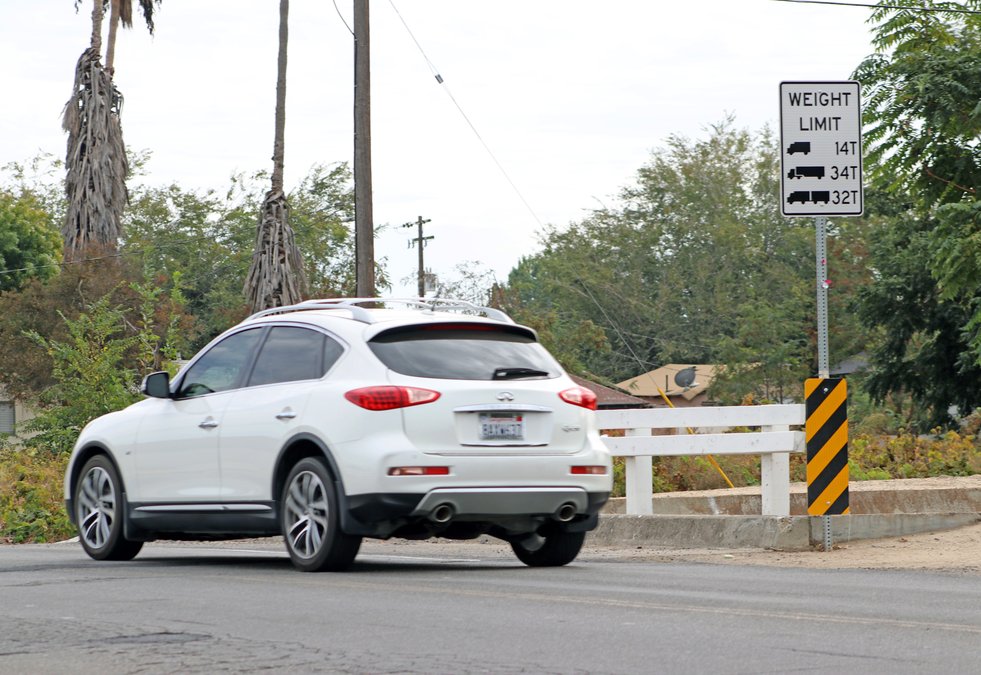
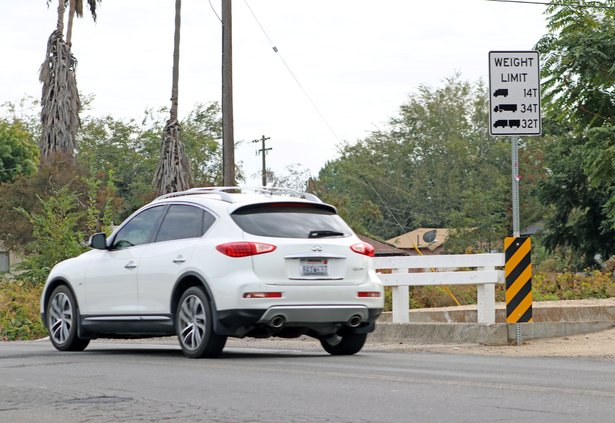
Earlier this year the Ceres City Council approved posting of signs limiting the weight of vehicles going over a 1921 canal bridge on Service Road due to its deteriorating condition. The weight limits included a single vehicle to 14 tons or less; a semi tractor-trailer rig to no more than 32 tons; and truck and full trailer to no more than 34 tons.
The weight limit rules out the fire department’s large Quint engine rolling over it since it weighs 43.5 tons.
No permitted loads are allowed to go over it.
Last week the council enacted a 35 mph speed limit over the bridge at the prompting of a 2024 Caltrans study of the bridge that identified new structural deterioration affecting the load-carrying capacity of the bridge.
The restrictions call for the following vehicles to refrain from using the bridge:
- Type 3 vehicles like passenger vehicles and school buses if they weigh over 14 tons. Most SUVs weigh 6,000 to 10,000 pounds and school buses can weigh between five and 18 tons;
- Semi-tractor-trailer rigs that weigh over 34 tons;
- Truck and full trailer (type 3-3) that weigh over 32 tons.
The matter was back before the council at its Oct. 29 meeting for two reasons. First, there was an error in the weight limits, specifically with the load restrictions for the semi-trailer combination, and truck and full trailer classifications inadvertently transposed. The existing load-restriction signage at the bridge, however, was installed consistent with the Caltrans bridge report and reflects the correct restrictions of 34 tons for a semi-trailer combination and 32 tons for a truck and full trailer.
Secondly, the city failed to include the 35 mph speed limit ordered in the Caltrans study.
According to the report to the council from City Engineer Mike Beltan, no temporary repairs or interim strengthening measures are proposed.
“The weight restrictions are necessary to ensure public safety and to limit further structural deterioration until the bridge can be replaced as part of the capital improvement project,” said Beltran.
In February Beltran said it may not be for another five to seven years for construction of a new bridge to wrap up. That’s because of the need to wait for federal funding and the up to 24 months to prepare professional engineering documents and undergo environmental review.
In February, the Ceres City Council approved getting the funding lined up and hiring a professional design firm to draw up plans.
Consor North America is providing design services for $517,782. The work will include surveying, geotechnical coordination, hydrology and hydraulic analysis, structural and roadway design, preparation of plans, specifications, and cost estimates (PS&E), and coordination with TID.
The city has been awarded funding of $277,000 through the Highway Bridge Program (HBP), which provides federal funds for the rehabilitation or replacement of deficient bridges. The remaining cost will be covered by $115,216.79 from Measure L tax funds and $145,565.33 from city accounts, none of which are General Fund dollars.
The city expects to apply for more grants to fund construction which will include Service Road widening to four lanes.
According to Beltran, recent inspections and engineering evaluations by Caltrans have determined that the bridge has “reached the end of its useful service life and requires replacement.”
“It is nothing that is a major safety issue for normal vehicles,” said Beltran, “but they do recommend putting load restrictions on the bridge.”
Beltran was asked about liability should a driver disregard the weight limit and cause failure.
“Obviously there would be a big investigation if a bridge collapsed due to somebody being overloaded,” said Beltran. “That would be something that would carry on through, like I said, PD’s reports in that investigation, and then, of course, insurances getting involved at that point also.”
The project also includes approximately 200 feet of roadway improvements in both directions along Service Road and Moore Road to tie into the new structure.
The city has known for some time of the bridge’s decay.
In 2021 former associate engineer Andy Austin, who earned a master’s degree in Structural Civil Engineering, resigned from his city post because he said his concerns about the bridge were not being heeded and complaints that the city was failing to do proper calculations to see if other projects engineered in-house meet California Building Code standards.
Austin said that after City Engineer Daniel Padilla left Ceres for Menifee, he discovered that Caltrans had downgraded the 1921 bridge for structural integrity. He claimed that then Public Works Director Jeremy Damas instructed him to not “work on that because I don’t know who’s paying for insurance.” Austin didn’t understand what Damas meant and explained “if you own it and it fails you’re going to be paying somebody in a court case.”
According to Austin, Padilla was aware of Caltrans’ summation of the condition of the bridge and didn’t feel it was important and that Austin could review it when he had the time.
Concrete bridges are susceptible to soffit spalling on the underside because bars rust and expand, pushing away concrete.
In 2021 Austin told the Courier that the box culvert bridge can no longer support vehicle load in excess of 36.05 tons.
Then City Manager Alex Terrazas said that Austin “reported a concern that he had about a bridge in the city which spans a TID canal, despite this inquiry being outside of his realm of expertise and outside of his assignment. Mr. Austin made no effort to determine within whose jurisdiction the bridge was within or who was truly responsible for addressing any engineering concerns.” Terrazas said Damas directed Austin to end his inquiries “until those entities could confer about overall liability issues. Mr. Austin disregarded those directives multiple times after being told that management was looking into the issues.”
In November 2021, Damas told the Courier that the city didn’t know who is responsible for the bridge, going as far to say that if Caltrans ordered the test, then the state is responsible for the bridge.