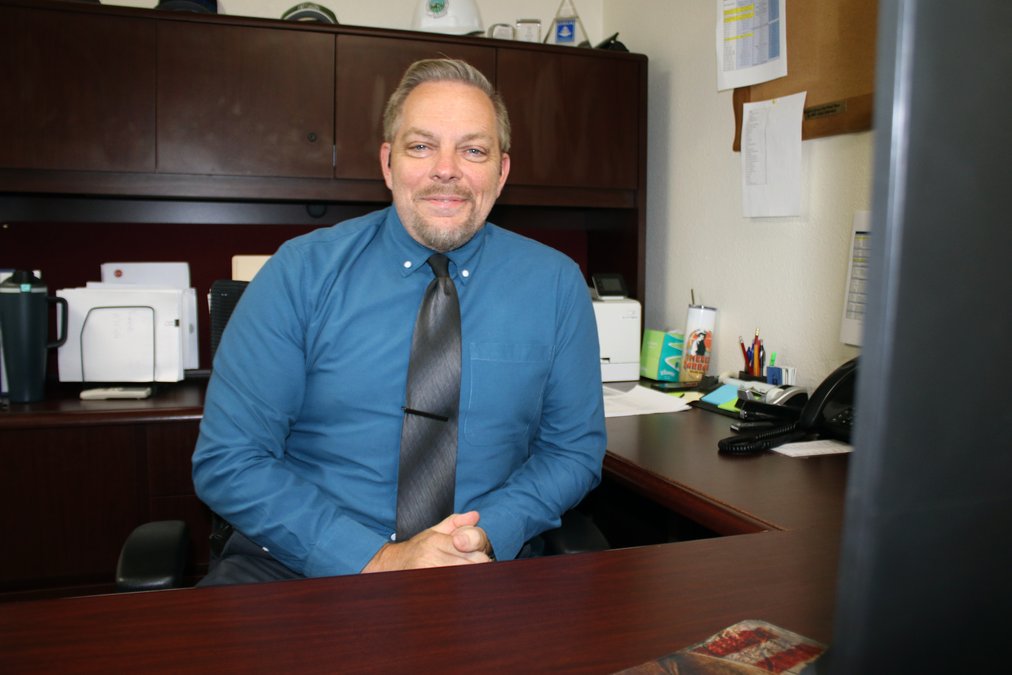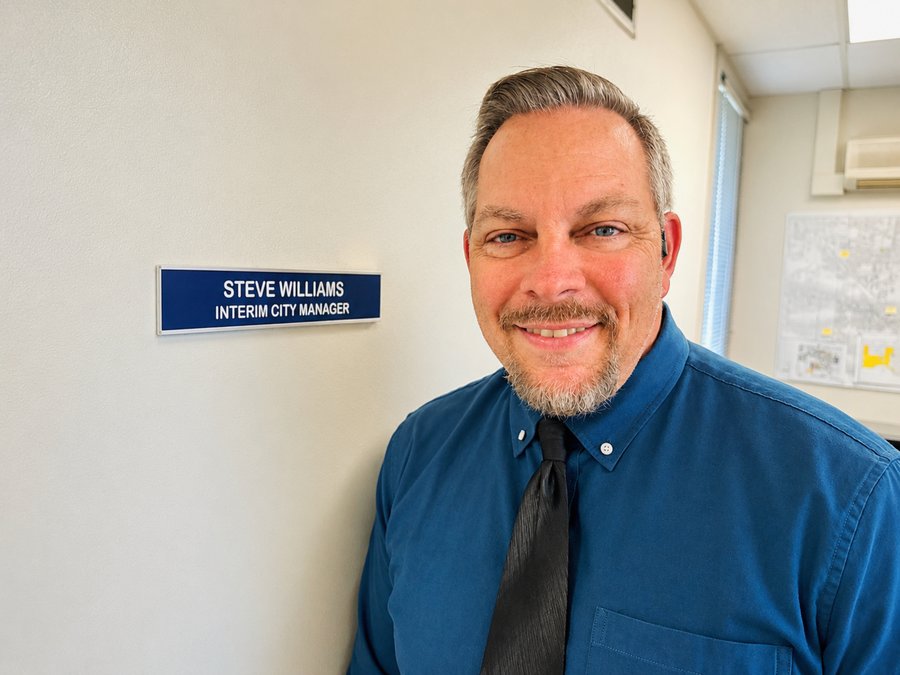
With the 2026-27 fiscal year budget behind him, the Ceres Courier sat down with interim Ceres City Manager Steve Williams on Friday to engage in an hour long question and answer session.
CC: How do things feel three months into the job?
SW: I feel good. I’m glad we got through the budget. I’m at the point now where I feel like I know where I need to go to get answers to things that happened before I got here. So it feels good in that sense. I’m kind of settling into the position, not settling in a way that I can slow down because it’s been so active since I started on April – I think it was 16th – with just the budget and the fire contract. We had labor negotiations going on, and trying to maintain services and figure out what the priorities of the council are. We’ve got the budget done. We got the fire contract signed.
Now I can start focusing on things that I have recognized over the last three months that I need to focus on, like improved communications both internally and with the public, making sure that we – now that we have a balanced budget –there are consequences to that, making sure that essential services continue in a way that is to the satisfaction of the community. That’s kind of my primary focus right now. Now that the budget is passed and we have to live with the $5.6 million reduction, maintain services and redesigning the way that staff in certain departments approach their work to make sure that the expectations of the community are met. So that’s now what I’m shifting to.
CC: Is this your second city manager role?
SW: I was the assistant city manager in Turlock for just a little bit interim. So they loaned me from the police department to the city manager’s office for about a year, and I went through a budget cycle and led them through that and did a lot of projects. This was somewhere around 2011. And then I did Angels Camp for about nine months or so until they found a permanent person. And after about four months, that person left the city so they asked me to come back again. So I did about another eight, nine months in Angels Camp. So a little under two years in total. And as soon as that was ending, because they now found their permanent person, this happened to be available.
CC: So much closer to home?
SW: It is. It was an hour and a half to get there. When I retired from Turlock Police in 2022 we bought a house in the Twain Harte. And so while I was up in Angels Camp, I was able to drive the 30 minutes from Angels Camp to Twain Harte instead of the hour and a half to get home (in Turlock).
CC: So you have two homes?
SW: Yeah, we have one in Turlock, and one in Twain Harte.
CC: Angels Camp has a population of 3,800. Is there any comparison with that city and Ceres?
SW: I would say there’s not a lot alike between the two cities, but the job itself of city manager is essentially the same. It’s just in a smaller city. It’s a little less complex in some ways, and more complex than others, because in a small town everyone knows each other, and there are things that go along with really small towns like that. But the job of city manager, in my humble experience, remains essentially the same – managing the resources that we have, providing the service to the community, being responsive to citizen concerns, and carrying out the direction of the City Council. Over there I had to wear a lot more hats, because we didn’t have enough staff. Over here, we have some more specialized staff. There is a lot more work to do here than there was there but the role of city manager, in my view, is basically the same. It’s a different complexity.
CC: Tell me about your upbringing where you were born and raised.
SW: Born and raised in Turlock. I went to Crowell Elementary School, Turlock Junior High School, and then Turlock High School. Graduated in 1990. While I was at in high school, I joined the Police Department as a police explorer. I was 15 years old, and when I graduated high school I was a dispatcher for about two years, until I went to the Police Academy at age 20. Got out of the Police academy and was hired by Turlock Police and I stayed there from the time I was 15 until I retired at age 51.
It wasn’t until about five to eight years into my career that I decided I wanted to start promoting. I didn’t have any formal education. I went to MJC just for a couple of semesters, but when I decided I wanted to start promoting, and there are education requirements, that’s when I went back to school. By that time, I got a full time job and I got a wife and I got kids and night classes, and all that. Eventually I got through all my schooling. I’m glad I did it.
CC: What did your parents do?
SW: My dad worked for Foster Farms for 47 years. At the time, when he retired, he was the longest term Foster Farms employee that they had. He ran the trucking division of the turkey live haul trucking division. And my mom kind of bounced around different jobs. My parents were divorced when I was 16. That was kind of rough and I’m an old child. My wife and I are opposites. I’m an only child and she’s one of seven. So we come from different ends of the family.
CC: So did you always want to go into police work?
SW: I was gonna be a golfer. That was my dad’s goal for me. I kind of grew up out at the Turlock Country Club. In the summer, he’d dropped me off there and I’d spend all summer every day out there. And so I was into golf, and then my parents divorced and I think caused me to need something different from that. So that’s when I got into the Police Department. When I got into the explorers and kind of tasted the law enforcement thing, that’s when I knew that’s what I wanted to do.
CC: Did you enjoy police work?
SW: Oh, I loved it. Well, I mean, it’s like any job, got ups and downs. I was a beat cop and canine and SWAT were my specialties. I had three different dogs over my patrol career, which was about probably maybe 12 years before I promoted a sergeant. So, canine, SWAT team were my, my kind of fun things to do when I was on patrol. And then once you start promoting, you have to give up those things. I couldn’t be on the SWAT.
CC: What rank did you leave there?
SW: Officially I was a police captain, but as the interim chief multiple times. I was a captain for just over 10 years.
CC: Tell me about your family.
SW: I’ve been married for 29 years. We have three kids. Our oldest is Trevor, lives in Torrance. He just got married in May. Our middle child is Allie. She lives up in San Andreas, works for a water district up there, which is, you know, right next to Angels Camp. So it was nice that when I was in Angels Camp 15 minutes away to go see Allie.
And then we still have Julia that lives at home. And she’s going to school and she’s like a behavioral therapist where she goes into people’s homes and helps them with behavior problems. So she enjoys that. And my wife is a school principal.
CC: Did you have any experiences in Ceres before coming here?
SW: I mentioned my wife Donna of 29 years, a school principal in Livingston right now. Donna Macklin was her maiden name, and big Macklin family at the time, this is in the 80s all went to Mae Hensley, and all graduated from Ceres High School. So my wife has a history here.
When I was in Turlock High School as a police explorer … Turlock didn’t have an ROP law enforcement program, but Ceres did. So I’d leave for fifth and sixth period of Turlock High School, I’d drive to Ceres High School to take their law enforcement class, and it was Louis Arrollo who was the instructor. So that’s my little connection to Ceres.
I’m glad they had that law enforcement ROP program. It was great.
CC: The fit feels good for you being here?
SW: It does. The staff has been great, very, very supportive and willing to help because they know that I don’t have the history. I don’t know a lot of things in terms of what has been done in the past, and processes that have been in place and are there processes in place. So they’ve been great. Really good with the community in terms of supporting me.
I feel there’s always room for improvement, and I’m sure I’ve made mistakes.
CC: When you become a city manager, how do you even get all the information about the community?
SW: The first thing I did is I read all of the Memorandums of Understanding, our employee agreements, front to back, cover to cover. We have five different MOUs. So all of the employee agreements, the personnel rules, and regulations, there’s a city council handbook, and there’s a set of city policies. So I took about a week and a half to just read through all of those. I have that but that tells me what I can and can’t do and what I have to do and what. I had to rely on staff to tell me. I had lots and lots of questions. We’re right in the middle of budget season. That was absolutely the priority for my first six weeks, all budget. And so I was having meetings with department directors and staff, and that was the priority. We wanted to get a balanced budget option presented to the City Council. We presented them with a couple of different options, but one of them was a balanced budget. That was the priority for me walking in.
Now, for the last month and a half, it’s been how do we live with those decisions? And now I’m transitioning towards improved communications and making sure we’re responsive to the needs of the community.
CC: I think you alluded to the fact at the last council meeting that you were gonna have a discussion with staff about who has to lock park bathrooms and who’s gonna take care of parks and how are you gonna take care of parks? Are the citizens gonna have to step up, maybe Adopt-a-Park type stuff?
SW: We have a formal Adopted-a-Park program and I would love it if people would step forward and help us right now. Since that last council meeting, we have developed a draft plan, a schedule of maintenance that guides staff and provides expectations as to what parks get serviced on what days, what city facilities get serviced on what days, and I am going to share that with the council and the public. But the idea is … come up with a plan itself and then make sure staff can handle it and knows that that is the expectation, and then share it with the public. So the public knows ‘my park should get mowed on this day, every week, or this day, every other week.’ We terminated the contract for the company that did lock the restrooms at night and unlocked them in the morning. We now have a plan of who locks the restrooms at night, so that all now falls onto staff.
CC: Does that fall to Public Works or does that fall to a police?
SW: It’s Public Works. Recreation part-time recreation staff is helping out a little bit with some of the locking and unlocking, but all the maintenance issues is Public Works.
And we are going to engage in a new agreement for landscaping services. But that is for the assistance, with the maintenance of the LLDs (Landscaping & Lighting Districts) and the CFDs (Community Facilities Districts), because those areas of town contribute additional taxes for that purpose, and it’s not going to come from the General Fund. So since there’s additional revenue within those districts, staff will be relieved a little bit by transferring some of those duties to a third-party landscaper.
CC: I thought you gave an impressive presentation on the budget. You came up with some plans to do significant slashing to balance the budget. Did you have prior budget experience?
SW: In Turlock. It was just one cycle, but I was heavily involved in that cycle, and it was during recovering from the economic downturn of 2008. So we’re in the 2010, 2011, 2012 area where I was, I did that over there. My experience in Angels Camp. I have a master’s degree in Business Administration, and one of my interests, when I was going through that program, was finance.
CC: Where did you earn that degree?
SW: Cal State. So I went to MJC for my associate’s degree, and I went to Grand Canyon University for my bachelor’s degree in Public Safety Administration and the master’s degree in Business with an emphasis in Leadership from Stanislaus.
So, in terms of this year’s budget I did have to dive in but I give full credit to the staff. A bulk of the responsibility fell on (Finance Director) Vanessa Portillo, but every department contributed. I had to ultimately be responsible for it, but all the credit goes to staff.
CC: What do you feel are some accomplishments that you’ve made here so far if you could toot your horn?
SW: No, I hate doing that, but I think the biggest one has to be the budget. I walked in on April 16, and I didn’t know at that time that we had $5.6 million to come up with somewhere.
CC: Would you have not taken the job had you known?
SW: No, I would have. I’m just saying I had no idea. I literally came from Angels Camp. I left there on a Friday and … there was a week between that and this. But in terms of accomplishments, it’s only been three months, so I don’t have a lot under my belt, but I would say the giving the council the option for a balanced budget is probably the most significant.
CC: Which leads me into the question about this half-cent sales tax measure in November. I know people are tired of more taxes and I know what it means if it does pass, because you get about $9.4 million annually, which is a big chunk of change that’s gonna bail out the city. But if it doesn’t pass? What then?
SW: I have to be careful with this one, because since we’re putting it on the ballot ... on duty, I can’t officially oppose or be in favor of it. I do have an opinion, I can’t just express my opinion while I’m working.
It would provide an additional locally controlled source of general purpose revenue that the City Council could appropriate. In terms of what would happen if it does or doesn’t pass, my opinion is it would be much like this year – decisions have to be made at that time with available resources. So I can’t say right now that if it does pass, this is gonna happen, or if it doesn’t pass, this is gonna happen. Because number one, I might not be in that position and I can’t commit the City Council to any specific thing regarding next year’s budget.
CC: But inflation is a reality and next year, if your revenues stay flat, your expenses go up and you have the same problem.
SW: Yep, costs continue to increase. City Council will continue making budget and service level decisions through the annual public budget process based on revenues available.
CC: I don’t have the numbers in front of me, but the original fire contract increase was supposed to be a lot bigger than it was. Is that accurate to say?
SW: I know that there was a roughly $500,000 reduction from what was initially proposed to what we ultimately agreed to.
CC: How was that accomplished?
SW: The negotiations for that fire contract went on months and months and months before I got here. So I got here at the very tail end. By April 15 when I started … there were still ongoing negotiations that I had to get up to speed on and jump in and represent the city in those negotiations. But essentially, it was a partnership and a collaboration between the city of Ceres, the city of Modesto, and the Modesto Fire Department, recognizing the financial situation, all three of those entities, recognizing the financial situation that we were in. We were able to smooth the cost over a five-year period instead of a one-time hit all at once.
So we were locked into a five-year agreement with specific amounts each year up to that fifth year, which was this year. But what happened was during those five years, the Modesto Fire Association negotiated different contracts with the employer, the city of Modesto, which caused increases, but they couldn’t charge us more because we were locked into those set dollar amounts each year. So this year, when that contract ended, because of those negotiated labor increases, it jumped. I want to say a million and a half dollars more, was going to be this year as opposed to last year. And we were able to drop about $500,000 of that increase off by smoothing it over five years.
CC: Are you talking about incremental increases?
SW: Yeah, instead of a one-time, $1.5 million (increase), we had a one-time $1 million increase, and that additional $5 million is spread over the term of the contract. Now, each year is a set increase.
CC: I know some people were opposed to contracting with Modesto because once it’s out of your hands, you’re kind of at the whim of Modesto.
SW: Well, we did a study on that where we analyzed what our cost would have been had we retained our own staffing, and compared that to what Modesto had charged us over the first five years – and now what they’re going to charge us over the next five years – and there was a substantial savings to the city.
CC: And probably better service, too.
SW: I was in the Turlock Rural Fire Department for about 25 years too so I have some fire lingo also. I was the volunteer assistant fire chief for about 20 something years. So we have four-person staffing on one of the pieces of apparatus that we didn’t have before. We have ALS, Advanced Life Support, in terms of paramedic service on fire engines, which we didn’t have before, and probably wouldn’t have had.
CC: Some have called for the city to improve communication with the public.
SW: I wish that I had a way to encourage the public in a meaningful way to participate more in council meetings. I think that would be great. I think that’s a sign of a healthy community, whether they’re willing to be involved and engaged. We do have the virtual participation option.
CC: Do you feel like residents have a good understanding of how the city works? We often read comments in social media who seem to think the city orders certain businesses into a city.
SW: I’m sure there is a lack of understanding, and that probably partially the fault of local government in general of, educating the community on the process because to get any business in the town is months and months of planning and negotiations.
A mom and pop store is very simplified as opposed to a different type of large business.
We do have an Economic Development Department, and there are certain tools that cities use in terms of networking with realtors, networking with the big name stores that are out there in terms of commercial industry. So there is some back and forth and some outreach from the city. If we recognize that there is a gap, if there is a need for a particular service, we do have the ability to reach out to a particular industry and solicit their consideration of our city. And that does happen here.
But in terms of, does the general public know it is such a complicated process with legal reviews and timelines and compliance with the planning zones and the municipal code? It’s very complex and I don’t think the general public has a holistic understanding of how complex economic development is in terms of attracting business.
CC: Pretty much all the issues are handled by staff but what would be an example of you personally calling somebody back?
SW: Staff will refer something to me, because somebody’s dissatisfied with a decision that was made or needs somebody at a higher level to fully explain it. So I’ve called multiple people because staff has asked me to. I pick up my phone; if I’m sitting here at my desk and I’m not doing anything significantly important, somebody calls my direct line, I pick up the phone and talk to anybody about anything. And sometimes they’re surprised to hear the city manager actually answering a cold call.
CC: Are you interested in being permanent city manager?
SW: Yeah, so I’m the interim right now.
CC: Where are they in the process of hiring one?
SW: At some point I suspect the City Council will authorize the recruitment of a permanent city manager. And that might be next week, that might be next year.
CC: They wouldn’t have to necessarily go on an executive search would they? What if they just said, ‘hey, Steve, stay on’?
SW: They have that authority to do that. It’s not common. It can save money. Typically a city would hire an executive recruiter, and that executive recruiter charges based on a percentage of the salary they’re trying to fill. So in a city with like Ceres’ size, you can probably expect $35,000 to $45,000 for an executive recruiter. We don’t have to have an executive recruiter. We can recruit in-house, our Human Resources Department could do the recruitment, in lieu of an executive recruiter doing it.
But I suspect that there will be an open recruitment. When you get to a city the size of Ceres … I think the general expectation is, even if they are satisfied with what I’m doing, and I’ve got the staff report, staff support, and I have the community report support – which would be the three ingredients I need if I’m gonna consider this job permanently – I think it’s expected with the size of city that they, that they do in recruitment. I won’t do it if I don’t feel I have staff and community support. If any one of those three are missing then I wouldn’t be the best fit for this job. But even if I have those, the support of those three groups, it never hurts to see what else is out there, because I’m not the end all and be all. There’s certainly people out there that probably could do a better job than me.
CC: Are you comfortable with the staffing levels here in terms of economic development, Community Development? It seems like (Economic Development Manager) Julian Aguirre is almost acting like a planning director. I know you have your contract people, Kelsey George and Leah Simvoulakis.
SW: Our Community Development Department is a community development director, which is vacant, an economic development manager, and then the planning staff. So, in the absence of a community development director, our economic development manager is serving as the interim community development director. So we have that position.
We have one planning technician and then we have a secretary. We had the option to either hire a full-time city planner – because we don’t currently have one – or continue in an agreement for part-time services with Gouveia Engineering the company that Leah works for. And because of the budget situation, because of the fact that unlike Engineering and much of Public Works, and much of Finance that are funded through multiple funds, the majority of Community Development is through General Fund. And because we were faced with such a challenge of reducing the General fund to present a balanced budget option, it’s ultimately my decision. I chose not to hire a full-time planner, but to continue the part-time services with Leah and Gouveia. But secondarily, we forecasted what we thought the demands on planning would be in the next fiscal year, in the current fiscal year and I was able to myself justify continuing with a part-time person instead of committing the funds to a full-time person, when there may not have been enough work to be done.
CC: I don’t know if you can answer it, but we have building going on in Modesto. We have building going on in Hughson. Nothing in Ceres. What’s the problem?
SW: I can tell you that in my short time here, I’ve talked to at least four developers that have expressed interest in residential and commercial. One of them was some industrial. So there are discussions that developers are having with the city, that are interested in developing in Ceres, and I think it is our job as a city to be as development friendly as possible and help these developers through the process. So that is one of my goals while I’m here.
Copper Trails is going through the LAFCO process right now. We expect it to go through the LAFCO process and be annexed into the city sometime around the end of the year, maybe beginning of next year. But that’s an area where there’s opportunity for significant residential, so commercial by the freeway.
CC: What are your interests, hobbies, or do you still golf?
SW: I wish. Family is the biggest. Like I said, married for 29 years, three kids, so that’s probably number one. I do like to golf. We go hiking, I mean we call it hiking but it’s more like walking up in the Twain Harte / Columbia area. So that’s kind of a hobby of ours. I spent my whole life in public service and I retired when I did I was golfing.
CC: Why did you decide you wanted to keep working after you retired?
SW: I retired at 51. Well, I got bored after about four months, and so I got my substitute teaching credential, because my wife’s a school principal, and I started helping out at her school when she had a teacher that called in sick instead of me sitting on the couch all day. So I did that during my first year of retirement.
I was kind of minding my own business and I got the call from Angels Camp, saying, ‘Are you interested in applying for the interim city manager position?’ And I interviewed, but for whatever reason, they picked me to do it.
CC: So when your wife retires, that’s when you plan to retire?
SW: Yeah. So she could retire in about four years. She could stay on for another eight to 10 years. So, if there is a right fit somewhere, five to seven years, something like that, or I can continue going from city to city if there’s a need, you know, a police chief or a city manager.
CC: Assuming you’re not here.
SW: Yeah. If this is the fit, then I would stay. I have five to seven years before my wife is seriously considering retirement.
CC: With your law enforcement background, what’s your feeling about Ceres PD and where they’re at?
SW: Tremendous respect for the Police Department. They are in a very good position right now in my humble opinion. The chief is doing a great job.
CC: But you’re going lose him soon.
SW: We are, yeah. At some point he’s gonna retire and just, like, the rest of us. He does a great job. We are at this moment fully staffed with our police officer positions. Now given, we have frozen positions but of the allocated positions that are funded, we’re fully staffed. It doesn’t mean we have our full complement of officers. I believe it’s 47 deployable officers. But then we have some in training. We have some in the Police Academy. But my takeaway is, we don’t have vacant positions that we can’t fill which is a good indication to me. It means people want to work here.
An example is the bicycle takeover that happened on Sunday (July 19). They were on that. It was great. We solicited the assistance of our allied agencies from all over the county, and we were fully prepared for that to happen, and it was a very effective operation I think because of the way the chief and his department recognized that that is a safety issue for this community, staffed appropriately, asked for the help we needed, and they did a great job. Very proud of them.