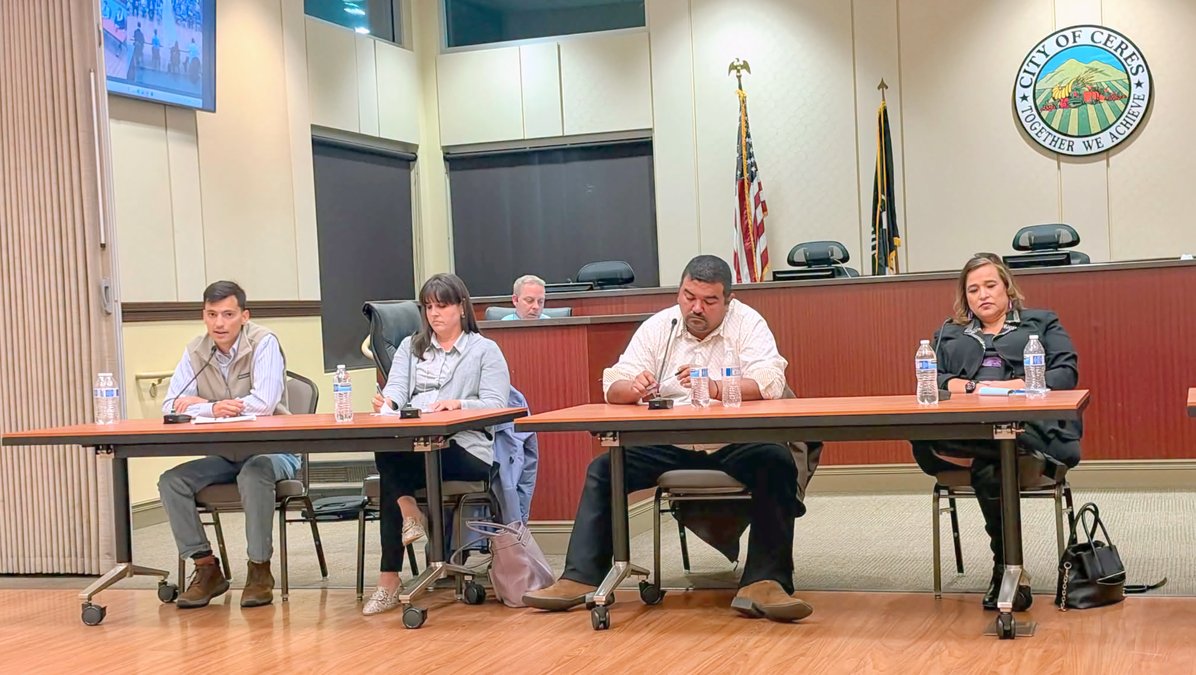
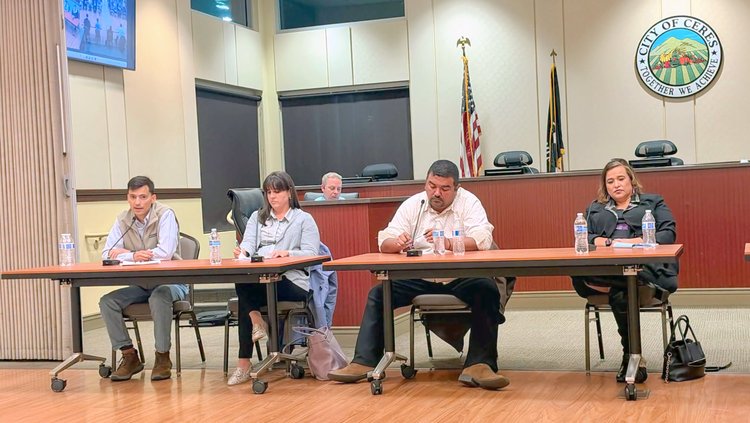
Despite the fact that some voters have already mailed in their ballots for the election next week, the Ceres Chamber of Commerce held a Thursday evening candidate forum featuring four Ceres City Council hopefuls and the two seeking the District 4 California State Senate seat.
Attending the forum at the Ceres Community Center were District 1 council candidates Gary M. Condit and Dorie Perez and District 2 council candidates Rosalinda Vierra and Jorge Guerrero. District 2 council candidate Galen Guzman was a no-show.
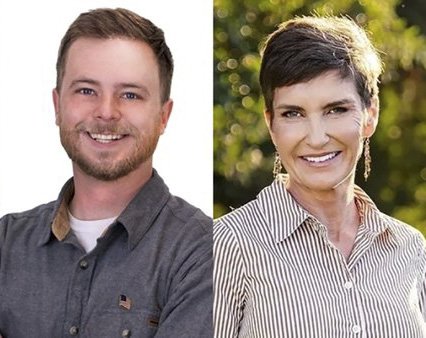
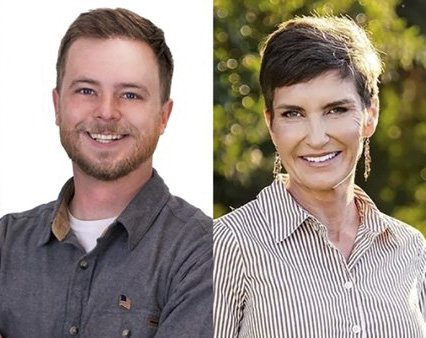
Also attending were Senate candidates Democrat Jaron Brandon and Republican Alexandra Duarte.
Each candidate spent time introducing their selves.
Condit said he has lived in District 1 for 18 years, and attended schools in Ceres and is now raising a family in Ceres.
“I am committed to making Ceres a better place and that’s why in 2023 I applied to be on the Ceres Planning Commission,” said Condit. “I’ve been on there for three years now. I’ve never missed a meeting and I’ve supported common sense development in my time. The fact why I’m running for City Council is because City Hall is a mess. I’m tired of the nonsense. It’s why I ran for mayor in 2024. Our city has been financially mismanaged. It is a zoo. Their current regime is running this city into the ground. And if we do not change course, it’s going to be too late.”
Condit said he wants to restore transparency and accountability across the board, and clean up the parks, streets and neighborhoods.
His educational experience includes a Modesto Junior College AA degree in Administration of Justice, a bachelor’s degree and he is a full-time employee with the Stanislaus County Sheriff’s office as an analyst.
Dorie Perez moved to Ceres in 2021 to raise a family. She earned her doctorate in American history at UC Merced a few years ago and has taught for the last 10 years, eight at the undergraduate level.
“I taught American history and cultural anthropology at UC Merced, the institution that was made for Central Valley graduates,” said Perez. “So I feel really proud of that work. I also taught middle school in high school, so I am not scared of anything at this point.”
“We could have gone to SoCal or NorCal, even Sacramento, but we decided that ultimately Ceres was where we could do some really good work with our family, get our kids into the schools that my wife had grown up in and be part of the Ceres institutions that she really grew up in and loved so much. So there was this intentional coming to Ceres in a way that I thought would really become a community for us and really kind of we could add to that community.”
Perez said she became a full-time foster mother. “I’ve had 21 children in my care, six of them at Ceres Unified Schools and programs. So the city of Ceres has a dear place in my heart as the spot where we decided to plant some roots.”
Perez said he decided to take part in the government.
“I saw some gaps in leadership. I really couldn’t get answers or phone calls from our current representation. So I felt really frustrated and I think a lot of my neighbors felt frustrated. So I spent some time on the Planning Commission. I applied and got onto the commission about two years ago. We’ve done some really kind of interesting juxtapositions between growth and keeping Ceres as its historical agrarian type of community, where we’re hoping to see growth but in a way that reflects that legacy.”
Jorge Guerrero explained that while he was born and spent 17 years in Mexico, he has always been a U.S. citizen by a birth because his dad was born and raised here.
His family moved from Mexico to Riverbank. He eventually bought a house in 1998.
“The city always seemed beautiful to me. I always loved coming to Ceres to work,” said Guerrero. “I used to work landscaping and I loved coming to Ceres to work because of the cleanliness and everything that was going on in the city.”
But he said “in the last six, seven years, I’ve noticed that the city has been in decline. The current council has been driving the city down. The reserves are going down. The parks look awful, the medians, everything that I used to love in the city … I saw that the government was driving our beautiful hometown to the ground. I decided to step in and try to be a change, try to be a make a difference.”
Guerrero has been actively involved for 17 years with Ceres Youth Baseball.
Guerrero has earned an AA degree in Business Administration and a BA in computer information systems.
“My passion is the youth, and last year when the swimming program – where my two oldest kids learn how to swim – was not available, that drive me nuts. That was something that I was very upset about because the youth is what is going to make this community better. That’s what drives people to come to live here and seeing the council, the three people who voted against that drive me nuts. And that’s when I said it has to stop. We got to make a change. We got to make a difference, and that’s why I’m here.”
Rosalinda Vierra, the incumbent District 2 councilmember, introduced herself as a mother of four and a certified success specialist at Modesto Junior College. She said she moved to Ceres about 25 years because it “doesn’t have the big city feel. I like the small city feel. I didn’t want a lot of the things you see in the big city.”
Vierra earned two associate degrees, one in social work and one in the humanities and social science, and also earned a bachelor’s degree in business management and a master’s in business administration. Vierra also stated that she has a graduate certificate in public policy and planning. She was also a small business owner for 15 years until a recent shoulder surgery.
Residency in Ceres for Vierra began about 25 years ago.
State Senate candidate Alexandra Duarte introduced herself as a farmer and a mom.
“I’m running because everything in our lives is getting more expensive, from groceries to gas and from insurance to water and power,” said Duarte, the wife of former Congressman John Duarte. “As a mom, I’m watching California become a place where our kids can’t afford to live anymore and that breaks my heart.”
She said “Sacramento politicians have sold us out. And they’re willing to cast any vote no matter how much it affects our local communities here, if it’s good for the big donors, if it keeps them in power. And the thing is this isn’t a Republican or a Democrat issue. We all know what’s happening.”
Her opponent, Democrat Jaron Brandon, was born and raised in Tuolumne County, where he has served as a county supervisor for six years, managing a $350 million budget.
Brandon touted a record of achievement in Tuolumne County, doubling the number of fire stations, increased deputy pay, improving the roads and reforming “our zoning and planning process to make it easier to build housing and support a business.”
“It actually does matter who we elect and send to Sacramento,” said Brandon. “Unfortunately, we are in rural areas. I am one candidate running to represent the 13 counties of District 4. LA is a county that has 13 state senators for one. It’s incredibly important that we send somebody there who can find compromise between two parties that seem to not be able to find any common ground on anything. Truth be told, we’ve been left behind by both parties.”
He spoke of the need to get funding for groundwater projects for sustainability, the ACE train extended, improve Highway 99, and build affordable housing “for people like me to stay in our communities and that next generation and for our seniors as well.”
“I want somebody who’s going to prioritize being effective. I want somebody who is going to go find friends. I want somebody who doesn’t sound like a consultant created brand. I don’t want somebody who is backed by corporate Sacramento type interests. I want somebody who has a record of actually getting that job done who is using that skill in Sacramento to get what we have lacked for a long time, which is the attention and seat at the table that we deserve.”
The first question was directed at council candidates: “What would you do to attract and retain local businesses, support small business owners and create good paying jobs in the city of Ceres?”
Vierra said economic development has been a focus of hers over the last four years on the council. She said she has “been working with businesses, reaching out to businesses, finding ways for them to invest because these are businesses that have to bring their own. They’re building, they’re starting, they’re buying the land, they’re building the infrastructure and it’s costly. And so I’ve been working online to make sure that people know that these lands are available. So if they do want to build a business here they can.”
Vierra noted that the city has helped G3 to build a large warehouse on Service Road at Crows Landing to create jobs and how the city approved plans for Stanislaus Regional Transit (StanRT) to relocate its transit center to Ceres on Crows Landing Road.
Guerrero said the city needs to “make it known that we’re a city that is open to attract businesses that we need in the city. It’s been talked about a lot about the gas stations, the chicken spots and the car washes. We need something different. We need a grocery store in District 2. We need sit-down restaurants. We want to attract people to come to our town.”
Perez said a potential Citizens Advisory Board for specific economic concerns “would be wonderful.”
As a member of the Ceres Planning Commission, Perez said that “I think a lot of people don’t understand that the Planning Commission doesn’t work to attract business; that’s not really our role. We either make sure it’s something that the city can handle and develop or it’s something that we would either make the city liable for something. So that’s really our decision making scope. Ultimately, I think some sort of private-public partnership where we have business owners themselves reaching out to their networks to build and grow our business community would be most helpful because then we’re using the people power, right?”
Condit said the city is not doing enough for economic development.
“We have 20 gas stations, 10 car washes in our city. We are the highest per capita compared to any city in the Valley when it comes to those sorts of businesses. We have 15 storage facilities in our city of 50,000 people. I think the residents of Ceres have spoken, they’ve been pretty vocal about what they want. They want more sit-down restaurants. They want family entertainment, youth opportunities, et cetera. And it starts with the Ceres City Council. They have to set the goals and the General Plan to really be specific about what we want to try to retain and they have not done that. As a planning commissioner I’ve taken the gas station issue on by recommending a moratorium that was voted down by the by the council. So we have to take certain steps if we want to compete with Turlock and Modesto because we’re going to fall behind. Like Jorge said, we have limited commercial land and we have to be very specific and targeted with how we use that.”
While not running for council, Duarte said local people need to make decisions about what suits their community.
“I think that the state makes mistakes with sweeping decisions,” she said. She specifically hammered on how the state has policies have driven up the cost of fuel.
Brandon said state leaders need to listen to “the locally derived plans of what your locally elected leaders would like to do.”
“I think there are job openings currently that cannot find people, and yet we have all these young people looking for jobs,” said Brandon. “We need to be able to get to the community colleges, the four-years, but also kids not going to college, certificated programs and training like the Volt Institute. That is something that needs to greatly expand so we’re not just training kids that move to another community.”
The candidates were asked what steps they would take to address homelessness in their respective districts and how they would you measure whether those efforts are working.
Brandon said Tuolumne County had a 40 percent higher homelessness per capita than San Francisco and reduced it by combining enforcement, drug treatment, and housing into a three-legged stool.
“The state put a lot of resources into addressing homelessness, which was a good thing,” he said. “The problem was the way it was spent and the way that it was allocated was not tied to, I think, key outcomes. It was very prescriptive. It was very top down. And so a lot of communities could not access that help. They couldn’t run them in the ways that they wanted to. So I would want to empower local leadership with continuing the funds that were promised to local governments, but making sure that they’re able to make decisions about the management of them. Really, the key is how do we prevent so many people from becoming homeless and from becoming chronically homeless over six months? You know, one of the other things we worked on was getting the drug houses shut down through the narcotics team. That is something that I think we can find bipartisan support on these regional trafficking and drug production networks, also making sure that we’re trying to create more affordable housing, both public and private, where somebody was working a minimum-wage job, 40 hours a week, is not so broke that if one event happens, they are on the street.”
Duarte said “it certainly involves making sure that we have the resources of jails and prisons, which not only provides a place for these people to step back into life. But it’s jobs, for our communities.”
She noted one gentleman in Nevada County running for city council has an inspirational story about being homeless, getting and staying and now “giving back to the community.”
Guerrero suggested Ceres’ homeless problem resulted from the city approving the Aegis Treatment Center on Mitchell Road in 2020.
Perez said the city has limited powers but said ultimately it’s about working with the county and the mental health providers and substance abuse counselors.
“I really think we need to look at the city of Denver and the way that they have managed to combine services with housing, to really reduce their homelessness population as a model for Ceres, but it’s a regional issue,” Perez said, “and California has, I think, something like 75 to 80% of the homeless people in the country. So we do need to bring in our state and federal counterparts.”
Condit said homelessness is a state and federal problem that “can’t be fixed with dollars. The state has tried that. As a council member, I believe in … a regional approach between the county and all the cities in Stanislaus. But we have to have compassion to deal with the issue of homelessness and we also have to have enforcement. And Ceres has a fairly large amount of homelessness in our in our city, and that causes blight, causes issues with families not wanting to go out. And it needs to be dealt with. And unfortunately, Ceres doesn’t have the budget to really deal with it. The city of Modesto has a homeless team that goes out and gives these people resources, housing, et cetera, tries to get them off of the street, and Ceres just is not in the financial spot to be able to do that, unfortunately.”
Vierra noted that the council did recently pass an ordinance that “address some of the trespassing and some of the loitering, especially in our parks to make sure it was safer. The people can just call the police department, have them come out if someone is loitering. Many of the businesses have now issued ‘no trespassing’ for many of the homeless that have been camping outside. So they call the police. They have the 602 letters already on file and the police can actually come out and address the issue.”
Vierra went on to say that “when I first came on to council we didn’t have anything for our homeless. I worked with the CARE program through CSOC to actually get the CARE program to start responding to, adjusting some of the resources that we had and needed here in Ceres.”
Perez said policymakers must have compassion, but also provide services.
“If you want to have better programs and see less homeless people, we need to fund services,” said Perez. “It’s not fair to ask our police officers to be at the front lines rather than kind of doing enforcement. They have to do something of a social work aspect, and that’s just not fair. So services really are the ultimate proactive solution.”
Duarte noted that Amador County has done a lot with their local sheriff in getting dollars from state and federal, for their homeless programs.
“How did they do it? Can we copy that in the other counties? Ceres has fantastic schools. Let’s look at how that was achieved and we can copy that in the other communities.”
Brandon said he helped pioneer Camp Justice, a county-operated, sanctioned homeless encampment in Sonora.
“Two bucks a day. We’ve been able to have 100 people in an area while closing encampments around is one of the most cost-effective pound-for-pound successes in addressing homelessness on main streets and in community backyards.”
He said his county’s approach was crafted after seeing Dignity Village homeless shelter in Modesto and seeing Merced work with veterans.
“It was seeing the downtown streets team picking up garbage. We were inspired by that. We brought that up to the mountains and that’s huge.”
A question asked what leaders should do to deal with major economic and geopolitical trends that will affect California communities.
Condit said cities need to have their budget in order and not deplete reserves.
“One of my priorities is really trying to get Ceres in a better financial spot with our reserves … because if that’s gone, you’re bankrupt,” said Condit, “and that is a terrible situation to be in. And unfortunately, that’s the reality that three of our members on the council have almost put us in.”
Brandon said he worries about the national debt as a looming issue, as well as artificial intelligence replacing jobs, data centers and energy usage and climate change.
Duarte took a swipe at Brandon for voting to raise supervisor’s pay, saying he “put it on the backs of the local people with a sales tax that would have affected food and gas. And when they didn’t go for that he fired two dozen local workers who had to go without a paycheck so that he could keep his. That is his solution with how to deal with things as an elected official.”
Brandon fired back at Duarte: “The difference between you and me is I’ve actually had to sit in the hot seat and make decisions that were difficult. I had to manage budgets. And yes, I achieved those priorities because we had to make decisions about what were priorities. I think it is a poor campaign and a poor candidate that chooses to only rely on negative attacks rather than talk about the question.”
He also said the pay increase was three percent.
Perez said AI has changed many aspects in life. While education is not within a councilmembers’ wheelhouse, she noted “Many teachers are going back to pen and paper because they are really heavily so reliant on technology that the kids cannot read, they cannot write, and they honestly cannot think for themselves because we have outsourced so much of that educational component to our tech overlords.”
Vierra said local leaders are often subjected to the mandates of state and federal leaders. She noted the city must find ways to meet housing needs balanced with job opportunities while “still trying to protect our farmland because we feed the nation.”
Guerrero said the focus of the city should be youth. “They’re the ones who are going to make or city better because if we don’t provide any resources for them … when it comes time for them to have a live and they’re gonna move out.”
All the candidates were asked the generic question of: “What changes, if any, would you make to approve police response times, emergency services, and neighborhood safety?”
Vierra said the council has been working on increasing police vehicles and upgrading patrol unit computers through grants.
Perez said the Modesto Fire Department’s response time is excellent, saying she nearly burned down her kitchen this year making French fries. She called for fully funding police to allow “them to do their work will also encouraging community policing.”
“There should be regular things that happen in a way that engages our young people, and also maybe underserved communities that have a fear of policing.”
Guerrero called for wasteful spending to be minimized “so
that we can provide the officers what they need” and fully staff approved positions.
Condit said he wants a fully staffed police department.
“The city council likes to claim that they’re fully staffed, but they’re not. There’s four police officer positions that are frozen. So it’s really prioritizing the budget to really get more boots on the ground because that’s what you, the public sees, and that’s what deters crime.”
Brandon said he was a proud proponent of Prop 36 to enhance manslaughter charges for drug traffickers. Duarte said she would make sure public safety have the funds to do their work and vote against funds given to EV owners and solar panels in the Bay Area while shortchanging police, our firefighters in the valley.
Duarte was asked to defend her choice to accept donations from large corporations with a history of political lobbying like Philip Morse tobacco.
“They are a legal company that runs a business in California and the federal level,” said Duarte. She went on to say it is horrible that the state has banned investing retirement funds in cigarette companies, and in gas and energy products. “So that comes back on our backs. That is the taxpayer that now has to bear the burden because we’ve got a state government, Sacramento saying, You can’t invest in businesses that are legal. That’s horrific and that’s hurting our working families, and it’s meaning that all young people, old people alike, are having to make a choice to leave California because they can’t afford to stay here.”
Brandon replied, saying her answer was “interesting” that she wants to have billions into Philip Morris with pension benefits “to be able to make them more money. Is that not exactly the type of corruption that that question is about?”
Vierra was asked how she has been supporting youth sports, one of her boasts.
She explained how she supported improving the lighting at George Costa Fields and was a t-ball coach at the Salvation Army Red Shield in south Modesto when they needed help.
The Senate candidates were asked about their stance on Proposition 3. Brandon said he supports the statewide measure for an income tax at the highest increment.
“I agree California is a high tax state,” said Brandon. “It’s a high cost state. For people who are making $150,000, $200,000 as a household or less, we need to be reducing all of the costs, but there are some things that are worth investing in. I’m not going to come up and categorically say in the name of simply shrinking government let’s cut things that work. We need to be investing in local education. We need to be investing in community colleges, CSU, UC, and all of those. So I’m in support of Prop 3.
Duarte said education is important but the state is wasteful with tax dollars. “I don’t think that our local communities here need to carry the burden of what’s going wrong in Sacramento. Sacramento has to be accountable for the money that they’ve already got.”
Candidates were asked what makes the the best candidate to represent the community.
Condit cited never having missed a Planning Commission meeting. An idea he wants to implement is to create a Citizens Advisory Committee specific to District 1.
“We would meet monthly, share ideas, let them know what’s going on in our community and really get the community involved because I think that is missing at City Hall – the lack of transparency, the lack of community involvement.”
Perez, who grew up in Fresno, cited her education and how she has understood issues important to the Valley.
“So when I think about my planning ethos, I know we have to move beyond 20th century thinking about parking spaces and think much more broadly. So I think I bring a lot of that to bear.”
Guerrero said what sets him apart is that he’s not a politician.
“A lot of times people who have degrees and different stuff about politicians, MBAs and this and that are career politicians that will go and sweet talk to you when they are in election time, when they’re in a campaign, when they want to be reelected. I’m not that person. What you see is what you get.”
He also said he will always be honest and transparent.
Vierra said “I’ve been pretty open when it comes to communication, making sure that you’re at least heard, even if we have different views. And I think that’s important because it’s important to understand both sides, regardless of what ultimately our views are, what the ultimate vote would be.”
She cited a great attendance record and that she studies the agenda and staff reports.